
The Witch of Wall Street
How Hetty Green Became America’s Richest Woman (and Its Most Misunderstood)
By Tiffany Isselhardt, with Ron A. Rhoades, JD, CFP®
It is October 1907, and a woman in a worn black dress is climbing the steps of J. Pierpont Morgan’s private library on Madison Avenue. Inside, the men who run America’s money are trying to stop its collapse — bank presidents, trust officers, the most powerful financiers in the country, all summoned by Morgan himself to plug a hole that is swallowing Wall Street whole.
The woman walks in, takes a seat, and assesses the room. She is the only female.
And she is the only one who isn’t afraid.
J.P. Morgan sits down next to her. They nod.
“You knew, didn’t you?” he asks.
She smiles. “Of course I did.”
“You’re the one who loaned the city funds those few months ago?”
“Yes,” she says, patting an envelope slightly sticking out of her bag. “And more this afternoon.”
“The courier can take that…” J.P. is interrupted by her hand. Of course she will walk it. She always does.
“I’ll add it to the loan they already have,” she states. “6% interest.”
Morgan smirked. “Of course it was you. I had a feeling.”
“I know you did,” She smiled quietly.
“One more thing,” Morgan whispers as he leans over slightly. “Hetty, how did you know?”
Hetty Green looks directly at him – only three years younger than her, Morgan is like a brother she must coach sometimes. “I read the papers,” she replies, “and I saw the signs. When rich folks start selling for cash, something’s coming.”
Morgan smiles. They both turn back to the others, still trying to figure out how “no one” could have predicted this. Morgan chuckles to himself, Hetty did. As a child, she read stock tables aloud to a half-blind grandfather in a New Bedford parlor – and she learned to predict it.
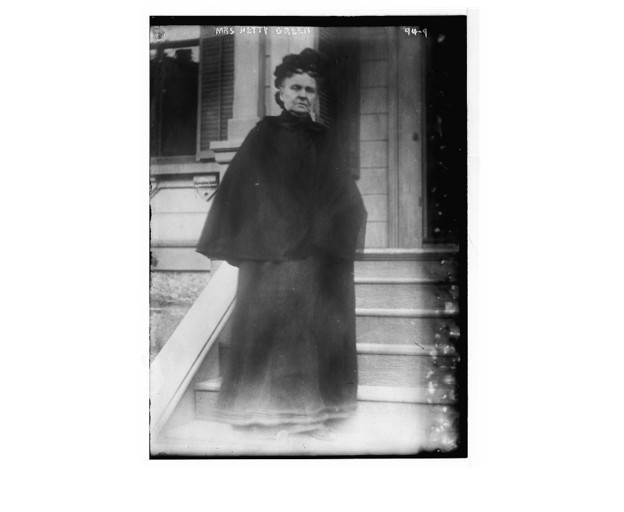
Mrs. Hetty Green by Bain News Service, no date. Held by the Library of Congress Prints and Photographs Division, Washington, D.C., 2014680543.
The Girl Who Read the Numbers Aloud
Henrietta “Hetty” Robinson was born in 1834 in New Bedford, Massachusetts, into a Quaker family whose whaling and shipping business had made her father and grandfather rich. She was the only one of their children to survive to adulthood, and from an early age, she was treated less like an heiress-in-waiting and more like an apprentice.
Every evening, as both her grandfather’s and father’s eyesight began to fail, Hetty read the financial news aloud.
“My grandfather’s eyesight was failing and my father’s, too. And as soon as I learned to read, it became my daily duty to read aloud to them the financial news of the world. In this way I came to know what stocks and bonds were, how the markets fluctuated, and the meaning of ‘bulls’ and ‘bears.’”
What she was reading bore little resemblance to a modern newspaper. Financial papers of the 1830s and ‘40s were dense, specialized broadsheets called price currents — subscriptions too expensive for most laborers to afford — packed with shipping manifests, commodity prices, and stock quotations from half a dozen unconnected regional markets at once. For a whaling family, this was how you tracked your own ships across the world’s oceans, alongside the price of whale oil and baleen back home. By the time most children her age sounding out simple words, Hetty was cross-referencing shipping arrivals against commodity prices across Boston, Philadelphia, Baltimore, and New York — a skill most people didn’t pick up, if ever, until well into adulthood.
The wharves themselves taught a different kind of literacy. Walking them with her father and grandfather, she watched whalemen negotiate not for wages but for a “lay” — a fixed fractional share of whatever the voyage eventually earned, sometimes after three or four years at sea with no income at all. She watched agents spread the risk of a single ship across eight, ten, twelve separate investors, so that no fortune sank with one bad voyage. She learned that agents collected their fees whether a voyage succeeded or failed — an early, uncomfortable lesson in how intermediaries get paid regardless of outcome. And she learned to inspect a barrel of oil and judge its worth by sight, the physical counterpart to the abstract numbers in the papers.
Then, in 1859, she watched the ground shift under her family entirely. A well in Titusville, Pennsylvania, struck petroleum — and a single day’s production from that well could match what a three-year whaling voyage produced in oil. Her father moved the family’s business toward New York almost immediately. Whatever else young Hetty absorbed from her childhood, this may have been the most durable lesson of all: even a fortune built over generations can be rendered obsolete by something nobody in the room saw coming — unless you’re paying close enough attention to move first.
Lesson #1
Financial literacy, for Hetty, was never a classroom lesson — it was a daily habit. She didn’t wait to be taught. She sought it for herself.
What Was Rightfully Hers
Hetty’s father died in 1865, leaving an estate of around $6 million — in today’s economy, measured as a share of the nation’s total output rather than simple purchasing power, that’s about $18.4 billion. Most of it, though, sat in trust, with Hetty entitled only to the income.
Then her aunt died.
Sylvia Ann Howland, Hetty’s spinster aunt, had all but raised her — “educated by her aunt, who had long stood in place of her mother,” as Hetty later put it. The two women had made a private pact years earlier: mutual wills, with a promise that neither would change hers without telling the other first. When Sylvia Ann died in 1865, her estate — worth roughly $2 million, close to $6.14 billion in today’s economic terms — split in an unexpected way: half to charities and caretakers, half to Hetty, in trust.
Hetty said she had never been told about the change. She produced a second page to the will, one she said Sylvia Ann had also signed, guaranteeing her the full amount. Whether that second page was genuine, or whether Hetty had forged it, became one of the most sensational trials of the era — hinging entirely on a single disputed signature.
To settle it, the court did something almost unheard of for 1868: it called in a mathematician. Benjamin Peirce, one of the era’s most respected statisticians, compared the disputed signature stroke by stroke against dozens of Sylvia Ann’s verified ones — one of the first times an American court leaned on statistical analysis, rather than simple eyewitness testimony, to settle a case. Peirce concluded that the signature wasn’t genuine. Hetty lost and kept only half of what she’d expected – the $1 million (about $3 billion today), in trust, meaning she could only use the income rather than the entirety.
She never forgot it. For the rest of her life, Hetty Green treated ownership as something you had to actively defend, not something that came with a name on a piece of paper — a lesson she’d apply, with far more success, to her own marriage two years later.
Lesson #2
The court battle taught Hetty a hard lesson early: knowing what’s rightfully yours means nothing if you can’t prove it and can’t keep it. From then on, she made sure she could do both.
Hetty took this lesson into her marriage. In 1867, at thirty-three, Hetty married Edward Henry Green, a wealthy 46-year-old businessman who’d made his own fortune trading in China. It was, on paper, an advantageous match. But Hetty insisted on a condition unheard of for a woman of her era: a prenuptial agreement, in which Edward formally renounced any legal claim to her money.
He signed it.
It would turn out to be one of the shrewdest decisions of her life — though neither of them could have known just how much that single clause would end up protecting.
Buy Low, Sell High, and Never Owe Anyone a Cent
With her fortune legally shielded from her new husband, Hetty turned her full attention to investing — and the strategy she built would not have a name for another eighty years.
Her first major move came almost immediately. After the Civil War, U.S. government bonds were trading at a steep discount, because investors feared Washington would redeem them in devalued paper currency rather than gold. Hetty studied the political landscape and concluded the opposite was more likely. She bought government bonds at the discount. In 1869, when the Public Credit Act confirmed gold redemption, she walked away with a profit of $1.25 million — worth something like $4.8 billion today.
“I buy when things are low and nobody wants them. I keep them until they go up and people are crazy to get them. That is, I believe, the secret of all successful business.”
It sounds simple. It wasn’t — it required research, discipline, and perseverance. The next test of the strategy came in a market where almost nobody else was thinking clearly at all.
By the 1870s, Hetty and Edward were living in London, right as British investors were falling over themselves for a piece of American railroad expansion. Capital poured across the Atlantic into a booming, loosely regulated market that came to be known simply as “American rails.” Most of the British money chasing it had no way to tell a sound investment from worthless paper — they were buying a growth story, not an asset.
Hetty wasn’t interested in stories.
“Before deciding on an investment, I seek out every kind of information about it.”
She wanted to know exactly what backed a given bond — the actual track, the land grants, the rolling stock — not just the promise of what a railroad might someday become. She was drawing a distinction between a security’s price and its true underlying worth – what Benjamin Graham later formalized into the “margin of safety”: the gap between what she paid and what something was actually backed by; the cushion that protected her if she turned out to be wrong.
She was just as deliberate at the negotiating table. Her advice to her son Ned, learned from decades of her own practice, was blunt:
“If anyone is fool enough to offer you the full amount, take it. If you are offered less, tell the man you will give him the answer in the morning. Think the matter over carefully in the evening. If you decide that it will be to our advantage to accept the offer, say so the next day.”
Don’t take the first offer. Stop. Breathe. Think. Remove the “must act now” pressure that ruins less disciplined investors and think about it. Any worthwhile business deal – or truly good offer – will wait for you.
She practiced what she preached, publicly, more than once. When two men from the Richmond Terminal offered to buy her 6,400 shares at $115 – fifteen dollars over market price – with a certified check, Hetty refused and countered with $125. They declined and left but soon appeared again – offering the $125 secured by collateral only if Hetty would agree to support their candidate for railroad president. She refused – the offer was not in cash – and if they wanted her vote, it would be $130 per share. Eventually, Hetty sold for $127.50 per share, or $816,000 total (using the Consumer Price Index, this would be $4,010 per share today – a total of $25.6 million).
“When I see a good thing going cheap because nobody wants it, I buy a lot of it and tuck it away.”
Tuck it away is the important part. She wasn’t flipping for quick gains — she was letting patience and time do the compounding work, decades before that idea had a textbook name either.
Lesson #3
The lesson underneath all of it: understand exactly what you own, refuse to be rushed into owning or selling it, and let the gap between price and true value do the protecting.
The Cost of Trusting the Wrong Man
In 1873, the Greens returned to the United States. That same year, Edward suffered heavy losses on Wall Street — the first of several. Hetty bailed him out. She did it again in 1875, and again in 1884, when Edward poured most of his own fortune into Louisville and Nashville (L&N) Railroad stock just before a financial panic sent the company’s shares collapsing. He was wiped out.
Hetty might have forgiven even that — she’d forgiven it twice before. But in 1885, the private bank where they both kept their money, John J. Cisco & Son, collapsed under the weight of its own bad debts, and this time Hetty found herself trapped inside her husband’s failure, not just paying to clean it up.
She had roughly $557,000 in cash and $26 million in securities on deposit at Cisco — about $68.5 billion today by the same economic measure. She wanted it out, immediately. The bank refused to release a dollar of it until someone settled Edward’s outstanding debt: more than $700,000, worth close to $1.8 billion today.
Hetty is said to have wrapped herself in black — dress, cape, bonnet, gloves — and marched into the bank herself to confront the situation directly. Whatever was said in that room, the outcome was blunt: she paid off Edward’s debt to free her own money, and she was done. It was the last time.
Edward moved back to his family home in Vermont; Hetty largely stayed in New York, running her business from a small desk she rented at the Chemical Bank. She was occasionally spotted in Vermont, overseeing work on the home or walking a “fuzzy terrier.” She insisted on giving Edward an income – an “allowance,” some would call it – to keep him in comfort: his clubs, books, newspapers. And when Edward became ill, she nursed him until his death in 1902.
Though the newspapers painted the picture of “Mister Hetty Green,” a 77-year-old Edward living almost anonymously in Vermont, as “elderly and simple gentleman” on his wife’s allowance, it is more probable that Edward and Hetty had come to an understanding – she would work and provide, while he – older, possibly defeated, and now reliant on her fortune – would return to his family home and enjoy a quieter life as old age came. It was not what society expected, but perhaps it is what they decided on together.
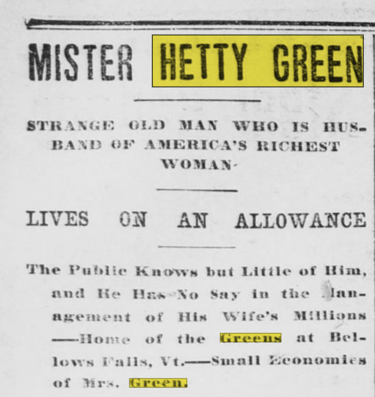
The 1898 newspaper clipping on “Mister Hetty Green.” It was published in both the New York Globe and the St. Paul Globe, as well as other newspapers across the country, suggesting how widespread both Hetty’s fame and Edward’s failure was at the time.
Where Edward had bet everything on one railroad, Hetty never made that mistake. Her obituary in The Standard-Times put it plainly:
“Her millions are in real estate scattered in many states of the Union, in railroad stocks, in bank stock, in mortgages and first class mining properties. She never left a dollar long enough alone for it to get away.”
Lesson #4
The Cisco collapse taught Hetty, at enormous personal cost, what she’d already believed in theory: a single bad bet shouldn’t be able to sink you — and it never sank her again.
Fourteen Dollars a Year
By the 1890s, Hetty Green had become the “Queen of Wall Street” in every sense but the one the newspapers preferred. She worked from her small desk at Chemical Bank, dressed in the same worn black clothing year after year, and walked nearly everywhere rather than pay for a carriage. One 1898 newspaper described her “trudging through the street, a few hundred thousands or a million or so in a newspaper parcel under her arm” — and claimed she once walked into her broker’s office with $250,000 wrapped in a borrowed morning newspaper. Whether that detail is exactly true or slightly embellished by an eager reporter is hard to say for certain; either way, it captures how the press had already decided to see her.
The same article claimed she spent as little as $14.68 a year on clothes — a figure that, converted for what it could actually buy at the time, comes to roughly $588 in today’s money. She was known to haggle with merchants over pennies, comparing prices the way most people compare prices on a house.
None of this meant that Hetty did not spend. It meant she was precise about when. For her daughter Sylvia’s entry into society — and the all-important task of a good marriage — Hetty “loosened her purse strings astonishingly,” hosting society dinners on gold-plate while continuing to dress, herself, “homely” and “practical.” (Sylvia would go on to marry into the extended Astor family circle, via Matthew Astor Wilks.) She was famously indulgent with her son Ned’s friends, once paying to replace an entire hotel’s worth of pillows after a pillow fight, because, as she put it, the boy “needs the exercise.”
Her frugality wasn’t miserliness so much as insurance. As financial historian Mark Higgins later put it:
“Those who practice it experience little fear during financial panics because they know they can live comfortably on almost no income. High society women mocked Hetty’s aversion to luxuries, yet many wished they had adopted her habits when they were forced to sell their possessions during financial panics. On such occasions, Green was among the few individuals with spare cash.”
Hetty could be sharp about it, too. Of an actress reportedly spending $300 a week on beauty treatments, Hetty was blunt:
“She had better invest that money for a rainy day. She won’t be popular always, and all the beauty doctors in the world can’t undo the work of Time. The money she is throwing away for such foolishness she will need for bread some of these days.”
But the same discipline that made her seem cold to society reporters made her genuinely useful to people with far less than she had. She was known to nurse sick neighbors personally. She once advised a young stenographer boarding nearby to leave her current lodgings for a cheaper hotel for working girls — one Hetty herself had quietly funded:
“Do not go out nights. Watch your company… Don’t figure in dollars, figure in pennies, and save them.”
Lesson #5
Thrift, for Hetty, wasn’t deprivation — it was the reason she had cash on hand when everyone else didn’t. And it left her plenty to be generous with, on her own terms.
The Panic She Saw Coming
On April 18, 1906, an earthquake leveled much of San Francisco. Most histories of the disaster stop at the rubble. But the earthquake set off a second, quieter chain reaction that Hetty was watching closely: insurance claims from the disaster, paid out largely by British and European insurers, pulled a massive amount of gold out of London and across the Atlantic. That drained the Bank of England’s reserves at the exact moment Britain sat at the center of the global gold standard. In response, British banks moved to discourage American borrowing, tightening credit across U.S. money markets. Interest rates climbed. The financial cushion protecting the American economy grew thin — and stayed that way for the next year and a half.
“I saw this situation developing three years ago, and I am on record as predicting it. I said the rich were approaching the brink, and that a panic was inevitable. There were signs which I could not ignore.”
The signs, in Hetty’s own telling, were concrete rather than mystical: some of Wall Street’s most solid men had started quietly approaching her to unload assets — mansions, even automobiles — a sign that fortunes assumed to be secure were actually cash-poor. Then the New York Central Railroad, a genuinely blue-chip institution, quietly came to her looking for a large loan. That, she said, was what “made me sit up and do some thinking.”
She spent the next several years converting real estate and other holdings into cash, stockpiling liquidity while the rest of Wall Street kept speculating on credit. Months before the crisis broke, she’d already lent New York City $4.5 million — worth roughly $4 billion today by economic share.
Then, in October 1907, two speculators tried to corner the market on United Copper stock. The bet collapsed, taking down the banks that had financed it and triggering runs on trust companies across the city. It became known as the Panic of 1907 — and it very nearly took the American financial system down with it.
Hetty was ready. She loaned an additional $1.1 million directly to New York City, at 6% interest — about $977 million today, by the same measure — telling a reporter afterward, “I might just as easily have secured 40%.” She extended credit to businesses and financiers she personally judged sound, trusting they’d repay once the panic passed.
And when J. Pierpont Morgan summoned Wall Street’s most powerful men to his private library to coordinate a response, Hetty Green was the only woman at the table.
Lesson #6
She hadn’t guessed. She’d been watching, for years, for exactly this — and she was the only one in the room who had the cash to prove it.
“A cabinet that could afford it” by John S. Pughe, published in Puck, v. 57, no. 1482, July 26, 1905. Held by the Library of Congress Prints and Photographs Division, Washington, D.C., 2011645722.
Queen or Witch?
For all of it — the discipline, the liquidity, the reputation among the men who did business with her — the newspapers had already decided what to call her. Where a man’s frugality was “shrewd,” Hetty’s was “miserly.” Where a man’s caution was “prudent,” hers made her a “witch.”
Some of it she earned honestly, by her own account:
“My family has been wealthy for five generations. We need make no display to insure recognition of our position.”
It was, in her telling, simply Quaker plainness applied to money the way she’d been raised to apply it to everything else.
Some of the mythology, though, was crueler than that. The most persistent story — repeated for over a century — claims she let her own son’s leg go untreated out of miserliness, leading to its amputation. A different account, attributed to her daughter Sylvia’s later recollection, tells a different story: that Hetty spent three days searching specifically for a doctor who would not amputate Ned’s gangrenous leg, and when that effort failed, spent years afterward seeking him specialist care and, eventually, a proper prosthetic.
Hetty operated, her entire life, inside a system explicitly built to keep her out. She could not buy a seat on the New York Stock Exchange. She could not sit on a corporate board. She could not vote.
“A woman hasn’t as many chances for making money as men have. She doesn’t hear of the opportunities for investment which are talked of day by day, in Wall Street and other financial centers.”
Neighbors who actually knew her, rather than read about her, described someone very different from the newspaper caricature. A woman who provided care for sick neighbors and complete strangers. Who advised a young stenographer to seek out better lodgings, to save her pennies by doing her own washing and mending, so that she could build a secure future for herself. Who, when she visited Edward in Vermont, would sit for hours with the town’s older residents, talked “with these village relics of local politics and finance as freely as if they were her fellow workers on Wall Street,” trusting them, one account noted, with a faith “almost childish.”
“I am not a hard woman, but because I do not have a secretary to announce every kind act I perform, I am called close and mean and stingy… I am a Quaker, and I am trying to live up to the tenets of the faith. That is why I dress plainly and live quietly. No other kind of life would please me.”
What She Left Behind
Hetty Green died on July 3, 1916, at eighty-one. Her final estate is valued around $200 million, which equates to $123 billion today. All of it grown from roughly $7 million in combined inheritance ($21.5 billion) through decades of her own decisions.
For context, here’s how she stacked up against the men history remembers as the era’s defining fortunes, each converted the same way: as a share of the U.S. economy at the time of their peak wealth, applied to today’s roughly $32.4 trillion economy.
| Financier | Estate Value | Year of Death | Today (share of GDP) |
|---|---|---|---|
| John D. Rockefeller | ~$900 million | 1913 | ~$701 billion |
| Andrew Carnegie | ~$475 million | 1901 | ~$637 billion |
| Hetty Green | ~$200 million | 1916 | ~$123 million |
| J.P. Morgan | ~$80 million | 1913 | ~$62.3 billion |
| Henry Clay Frick | ~$142 million | 1919 | ~$55.2 billion |
She wasn’t the richest person of the Gilded Age. But she built a fortune that outsized Morgan’s and Frick’s — the very men she was invited to sit among when the country’s finances needed saving — without a Wall Street seat, a vote, a business partner, or a single dollar of borrowed money. Her fortune split evenly between her two children, who, when they both died without heirs of their own, distributed what remained to 64 charities and educational institutions.
She’s buried beside Edward in Bellows Falls, Vermont. Her tombstone reads: Hetty H. R. Green. His Wife.
It’s a strange final line for a woman who spent her life insisting, in increasingly public ways, on being entirely her own.
What this means for You
- Read the numbers, even before you fully understand them. Literacy comes from exposure, not perfection.
- Know exactly what’s legally yours and be prepared to fight to keep it.
- Understand the difference between a security’s price and what it’s actually backed by — that gap is your protection when you’re wrong.
- Don’t let urgency make your decisions for you. Sleep on it.
- Diversify. One failed bet shouldn’t be able to sink you.
- Live below what you could spend. It’s not deprivation — it’s the reason you’ll have cash when everyone else doesn’t.
It’s the same short list Benjamin Franklin left in his will, and the same one Arkad hands down in The Richest Man in Babylon. Hetty Green just proved it worked — in an era, and inside a system, that did not want to admit women.
Enjoyed this article?
We write about these topics because we believe informed people make better financial decisions. If that resonates, we’d love to stay in touch.
Sign up for our e-newsletter and receive “Ten Tough Questions You Should Ask Any Financial Advisor” — a free PDF guide to help you find a fiduciary, fee-only advisor you can truly trust.
A Note on the Numbers
Historical dollar figures in this piece are converted using the “relative share of GDP” method: each amount is measured as a percentage of the U.S. economy in the year it occurred, then applied to today’s roughly $32.4 trillion economy (IMF estimate, 2026). Historical GDP figures are drawn from MeasuringWorth.com’s economic dataset for “relative output.” This method reflects economic power and influence — how large a fortune was relative to the world around it — which is the right lens for comparing wealth and financial decisions across eras. It is deliberately not used for Hetty’s Richmond Terminal Stock purchase and $14.68 annual clothing budget: for these, a standard cost-of-living (CPI) conversion is the appropriate comparison. Where sources disagree on a historical figure, such as the exact size of Hetty’s inheritance or her total estate at death, we’ve picked the one supported by more verified historical sources.
About the Authors
Tiffany Isselhardt is a public historian, author, and the Director of Business Development for Scholar Financial, a practice within XY Investment Solutions LLC. She has spent her career working across financial services, museums, historical interpretation, and education – with a dedication to utilizing history to promote more inclusive communities and inspire youth to reach their full potential.
Ron A. Rhoades, JD, CFP® is an Associate Professor of Finance at the Gordon Ford College of Business, Western Kentucky University. He also serves as a financial advisor at Scholar Financial, a practice within XY Investment Solutions LLC. With a background as both an attorney and a CERTIFIED FINANCIAL PLANNER™ professional, Ron is a nationally recognized authority on the fiduciary duties of financial advisors.
Disclosures
This article is for educational purposes only. While the characters depicted were real people, and many of the events actually happened, the scenes described between Hetty and J.P. Morgan are fictionalized. Very few accounts of Morgan’s meeting between Wall Street’s giants – which included Hetty Green – exist to tell us what happened in that room, or whether they knew about Green’s actions with the city of New York.
Scenarios and references to real people or experiences are used solely to illustrate educational concepts. These examples may not apply to your individual circumstances. It should not be construed as financial, legal, tax, or investment advice, nor as a recommendation to implement any specific strategy, product, or investment. As a fiduciary, we provide advice tailored to each client’s goals and financial situation. Consult with a qualified financial professional before making investment decisions.
Advisory services are offered through XYPN Sapphire and its various IAR brands under which it operates. XYPN Sapphires is an SEC registered investment adviser. For additional disclosure and privacy information, please visit XYPNSapphire.com/disclosures.
Sources
Adler, Dorothy R. British Investment in American Railways, 1834–1898. University of Virginia Press, 1970.
Davis, Lance E., Robert E. Gallman, and Karin Gleiter. In Pursuit of Leviathan: Technology, Institutions, Productivity, and Profits in American Whaling, 1816–1906. University of Chicago Press, 1997.
Eschner, Kat. “The Peculiar Story of the Witch of Wall Street.” Smithsonian magazine, November 21, 2017.
Graham, Benjamin, and David Dodd. Security Analysis. McGraw-Hill, 1934.
“Hetty Green, Her Thrifty Ancestors and the Accumulation of a Fortune.” The Standard-Times (Evening Standard), New Bedford, Massachusetts, July 3, 1916.
“Hetty Green, on Vacation, Talks as Her Relaxation.” St. Louis Post-Dispatch, August 30, 1908.
Higgins, Mark. “The Story of Hetty Green: America’s First Value Investor and Financial Grandmaster.” Financial History, Museum of American Finance, Fall 2022.
Hohman, Elmo P. The American Whaleman: A Study of Life and Labor in the Whaling Industry. Longmans, Green & Co., 1928.
Johnston, Louis, and Samuel H. Williamson. “What Was the U.S. GDP Then?” MeasuringWorth.com — source for historical GDP figures used in this piece’s economic-power conversions.
“Mister Hetty Green.” New York Globe, September 11, 1898.
Nantucket Historical Association. “Short Lays on Greasy Voyages: Whaling and Venture Capital.” nha.org.
Slack, Charles. Hetty: The Genius and Madness of America’s First Female Tycoon. Ecco, 2004.
“Stories and Anecdotes of the Late Hetty Green.” Ledger-Enquirer (The Columbus Enquirer-Sun), Columbus, Georgia, July 24, 1916.
Wallach, Janet. The Richest Woman in America: Hetty Green in the Gilded Age. Nan A. Talese/Doubleday, 2012.


