
A Guide to the Fundamentals of Estate Planning
A Conversation with Professor Bear: Securing Your Future Family
by Chris Brown, PhD, CFP® and Ron A. Rhoades, JD, CFP®
Important Disclaimer
This guide is provided for informational and educational purposes only and is not intended to be a substitute for specific, individualized legal, tax, or financial advice. The content, including all narrative elements, characters, and scenarios, is based on general principles of estate planning and is not an endorsement or recommendation of any specific course of action. Estate planning laws – including those concerning wills, trusts, probate, guardianship, and powers of attorney – are governed by state and federal law, and they vary significantly by jurisdiction. The information herein may not be current or applicable to your specific state or personal circumstances.
Scholar Financial, Professor Bear, and the authors of this document are not providing legal or tax advice. While Scholar Financial can guide you through the estate planning process, you should consult with a qualified, independent estate planning attorney licensed in your state to discuss how current laws apply to your specific situation, draft legal documents, and ensure the proper execution and funding of your estate plan. You should also consult with a tax professional regarding the tax implications of your plan. Scholar Financial’s financial advisors can assist with the financial implementation of your plan (such as asset titling and beneficiary designations) but do not provide legal or tax counsel. Advisory services are offered through XYPN Sapphire and its various IAR brands under which it operates. XYPN Sapphire is an SEC registered investment adviser. For additional disclosure and privacy information, please visit XYPNSapphire.com/disclosures.
Introduction: The Unasked Question
The polished mahogany table in Professor Bear’s office gleamed under the soft light. The air was filled with the faint scent of old leather and new beginnings – a fitting environment, perhaps, for the topic at hand.
Seated across from the Professor – a kindly, impeccably dressed gentleman whose silver-rimmed glasses perched low on his nose – were Amelia and Ben. They were the picture of vibrant young adulthood: Amelia, a data analyst with a sharp, inquisitive mind, was seven months pregnant, cradling a hand protectively over her small bump; Ben, an engineer, was leaning forward, earnest and slightly overwhelmed.
“Thank you for meeting with us, Professor,” Ben started, running a hand through his hair. “We’re excited, obviously. Terrified, too. Our financial advisor, Sarah, said we absolutely must talk to an estate planning attorney now that a baby is coming. But honestly, I always thought estate planning was just for retirees or the really wealthy.”
Professor Bear smiled a warm, knowing expression. “That’s a common misconception, Ben. It’s perfectly understandable. Most people associate the term ‘estate’ with sprawling mansions and inherited fortunes. But the truth is, if you have a family, if you have assets, or if you simply have opinions about your own future, you have an estate. And you need a plan.”
He paused, leaning back slightly in his chair.
“Let me pose a question to set the stage for our discussion,” the Professor continued, his voice shifting to a narrative whisper. “Imagine, for a moment, that tonight, on the way home, you are both involved in a sudden, unexpected accident. You are both injured, but neither fatally. You are simply… unconscious. You are alive, but unable to speak, to communicate, or to sign any document.
“Your assets – your bank accounts, your 401(k)s, your mortgage – are suddenly locked away from the outside world. Your future child is due in two months. Your parents rush to the hospital, desperate to help.
“The question is this: Who, legally, gets to walk through the doorway to your life? Who has the immediate, undisputed authority to pay your bills, manage your investments, speak to the doctors, or sign papers for you both?
“Most people assume a spouse or a parent automatically steps in. But in that moment, with no plan, your family will discover that the person who walks through that doorway is not a loved one, but an adversarial stranger: The Court.”
Amelia’s hand tightened on her stomach. “That … is terrifying,” she admitted.
“That, Amelia, is why we are starting with the most critical element of estate planning for a young family: Incapacity Planning.”
Ch. 1 – The Core Question: Who Decides? (Incapacity Planning)
The fundamentals of estate planning, particularly for a young couple, begin not with death, but with life. Specifically, the risk of a life temporarily interrupted – the scenario of being alive, but legally disabled or incapacitated. This risk is statistically far higher than the risk of untimely death.
“Estate planning is often seen as death planning,” Professor Bear explained, his voice gentle but firm. “But over the next hour, I want you to re-label it in your mind. Estate planning is life planning and incapacity planning first and foremost. It’s about ensuring your voice is heard, even when you can’t speak.”
He tapped a finger on a small stack of papers. “We resolve Hook #1 – the doorway of silence – by granting formal, legal authority to the people you trust. We do this through two critical documents: the Durable Power of Attorney for Financial Matters and the Advance Health Care Directive (or Health Care Power of Attorney).”
1.1. The Financial Gatekeeper: Durable Power of Attorney (DPOA)
A Power of Attorney is a document in which you, the Principal, appoint another person, the Agent (or Attorney-in-Fact), to act on your behalf.
“Think of your DPOA, Ben, as a key,” Professor Bear said. “It’s the key that unlocks your financial life. When you are incapacitated, that key grants your agent the power to step in and manage your affairs without having to go to court.”
What makes it “Durable”?
“The critical word here is ‘Durable’,” Amelia noted. “What does that mean in this context?”
“It’s a magnificent legal term, Amelia,” the Professor chuckled. “A non-durable POA automatically becomes invalid the moment you become incapacitated. That defeats the entire purpose of incapacity planning! A Durable Power of Attorney is specifically designed to survive your subsequent disability or incapacity, or even only become effective upon it. It ensures that the powers we grant remain in force exactly when you need them most.”
Powers Granted Under a DPOA
The DPOA is sweeping and powerful. It’s an authorization for your Agent to conduct almost any financial transaction you could conduct yourself.
The Financial Agent’s Authority typically includes:
- Paying routine bills and managing bank accounts.
- Filing tax returns and dealing with the IRS.
- Managing investment accounts, buying and selling securities.
- Collecting benefits (Social Security, pensions).
- Dealing with real estate (e.g., selling a home, refinancing a mortgage, managing rental properties).
- Handling legal claims and lawsuits.
- Interacting with your financial advisor and firm, such as Scholar Financial.
“Because the DPOA is so powerful, the choice of Agent is paramount,” the Professor emphasized. “This person must be absolutely trustworthy, organized, and financially astute. They are stepping into your shoes, and their decisions bind you.”
The Springing vs. Immediate DPOA
Professor Bear presented a common area of client deliberation. “When should this key be operational? We have two main approaches:”
- Immediate DPOA (Effective Now): The document is legally effective the moment you sign it. The Agent is authorized to act immediately, though most couples only use it if one spouse is unavailable or if one becomes incapacitated. This is generally the cleaner, legally more accepted approach because there is no doubt about when the power starts.
- Springing DPOA (Effective Upon Incapacity): The document ‘springs’ into effect only after a defined event occurs, typically two physicians certifying your incapacity. While this sounds more protective, it can cause delays and legal arguments at the moment of crisis – the very time you need immediate action. And it is very difficult to obtain physician signatures.
“I almost always recommend the Immediate DPOA, naming each other first. You already trust each other completely, and it removes the administrative headache of proving medical incapacity when time is of the essence,” Professor Bear concluded.
1.2. The Health Care Spokesperson: Advance Health Care Directive (AHCD)
“If the DPOA is the key to your financial life, the Advance Health Care Directive (AHCD), also sometimes called a Health Care Power of Attorney or Health Care Proxy, is the key to your medical care,” Professor Bear explained.
“This single document does two things, which is why it’s so powerful:”
- It names a Health Care Agent: The person you authorize to make all medical decisions for you when you cannot make them yourself.
- It provides your instructions: It allows you to spell out your wishes regarding life-sustaining treatment, pain management, and other end-of-life considerations.
Amelia asked, “Doesn’t Ben automatically get to make my medical decisions as my husband?”
“A superb question, Amelia, and one where the law is often murky,” the Professor replied. “In most jurisdictions, yes, a spouse is first in line. However, hospitals, which are deeply risk-averse, often require written proof of authority, especially for major decisions or when family members disagree. The AHCD removes all doubt and all delay. It is your legally recognized voice.”
Key Decisions in an AHCD
Professor Bear outlined the serious decisions that must be contemplated in the AHCD:
- Life Support/Sustaining Measures: Defining the circumstances under which you would or would not want life support, ventilators, or feeding tubes employed if recovery is deemed impossible.
- Palliative Care: Expressing your desire for comfort and pain management.
- Organ Donation: Stating your preference for organ or tissue donation.
- The Agent’s Role: Clarifying that your Agent’s authority begins only when your treating physician determines you lack the capacity to make or communicate decisions.
He offered a helpful visualization:
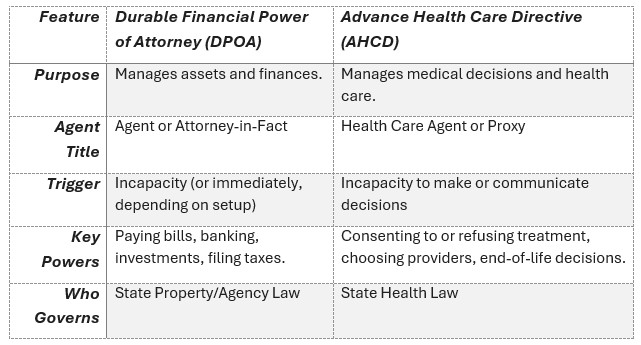
“By signing these two documents – the DPOA and the AHCD – you have answered Hook #1. You have designated your proxies. You have shut the court’s doorway, and you have handed the keys to the people you love and trust,” Professor Bear said, closing the first chapter.
Ch. 2 – Planning for the Littlest Legacy (Guardianship & Temporary Authority)
The atmosphere in the room softened slightly as the discussion moved from the couple’s personal incapacity to their imminent child. The financial stakes, while high, paled in comparison to the emotional stakes of their new parental responsibilities.
“Now we must discuss the most important piece of your estate plan, Ben and Amelia: the safety net for your child,” Professor Bear said, adjusting his glasses.
“Imagine a far more tragic scenario than temporary incapacity. Imagine that, heaven forbid, something happens to both of you permanently while your child is a minor. The child is safe, but your seats at the table are empty.
“The question is this: Where does your child go tonight? Which adult legally assumes the role of parent, making all the vital decisions about where they live, what school they attend, and what faith they are raised in?
“Just as with incapacity, without a written, notarized plan, that decision is left entirely to the discretion of a stranger – a probate judge – who, despite their best intentions, does not know your family, your values, or your wishes.”
Amelia’s eyes were wide. “We know we need to name a Guardian in our Will, but we haven’t officially settled on one yet. It’s a huge decision.”
“It is,” the Professor affirmed. “And it’s a decision that must be made, as the legal term for this arrangement is Testamentary Guardianship – naming a guardian in your Will, to take effect after your deaths. This is the permanent plan, but we must also cover the temporary scenarios.”
2.1. Testamentary Guardianship (The Permanent Plan)
The appointment of a guardian in your Will is where you exercise your parental right to choose the person who will care for your child until they reach the age of majority (usually 18).
“When you name a Guardian, you are appointing two roles in one person,” Professor Bear clarified:
- Guardian of the Person: This person raises the child, making decisions about their daily care, education, religion, and residence. This is the fundamental, parental role.
- Guardian of the Estate (or Conservator): This person manages any assets the child owns or receives (like life insurance proceeds or an inheritance) until the child turns 18. This person is usually required to file regular accountings with the probate court.
“For many people, these are the same person, but they don’t have to be,” explained Professor Bear. “You could name Ben’s sister to be the Guardian of the Person, raising the child, and your CPA brother to be the Guardian of the Estate, managing and distributing the money.”
2.2. The State’s Solution: Temporary Authority for Minor Children
The single most overlooked piece of planning for young parents is addressing the short-term absence – the very risk that spurred Ben and Amelia to action in the first place. This is where the specific state forms for temporary grants of authority become critical.
“Let’s return to the unexpected coma. You are both incapacitated, but not deceased,” the Professor instructed. “You have your DPOAs and AHCDs, which cover you, the parents. But who can authorize an emergency appendectomy for your child? Who can enroll them in summer daycare? Who can talk to the school principal?”
“The AHCD and DPOA are yours,” Professor Bear emphasized. “They do not cover your minor child. For that, we turn to state-specific instruments, often known as a Parental Power of Attorney or Minor Child Power of Attorney.”
The Parental Power of Attorney (PPOA) is a temporary delegation of parental authority, granting an Agent the power to make urgent decisions for your minor children when you are temporarily unavailable.
Key characteristics of the PPOA are:
- Temporary Limit: Most states impose a time limit on these documents – typically six months to one year – to prevent them from being a backdoor form of permanent custody transfer. You can, however, execute a new PPOA upon the expiration of the old one if needed.
- Specific Powers: The Agent is granted the authority to make critical health and educational decisions, including:
- Consenting to medical, dental, or mental health treatment, even emergency surgery.
- Enrolling the child in school and inspecting educational records.
- Retained Rights: Importantly, the PPOA does not terminate your parental rights or transfer custody. It simply allows the Agent to act in your absence. You remain the legal parent, and you can revoke the PPOA at any time.
“When you leave your child with grandparents for a two-week vacation, or if you were to be suddenly hospitalized, this document is what gives your chosen caregiver the legal standing to sign a consent form or speak to a physician without being told, ‘Sorry, you are not the legal guardian’,” the Professor said. “It’s the simplest, yet most vital, insurance policy for your child’s immediate wellbeing.”
Ch. 3 – The Tale of Two Documents (Wills & Trusts)
With the immediate incapacity issues addressed, Professor Bear transitioned to the planning that occurs upon death – the distribution of the estate. This is the territory most people initially think of when they hear “estate planning.”
“We have protected your child’s care and your personal financial and medical authority. Now, we plan for what happens to your assets when you are no longer here,” the Professor announced.
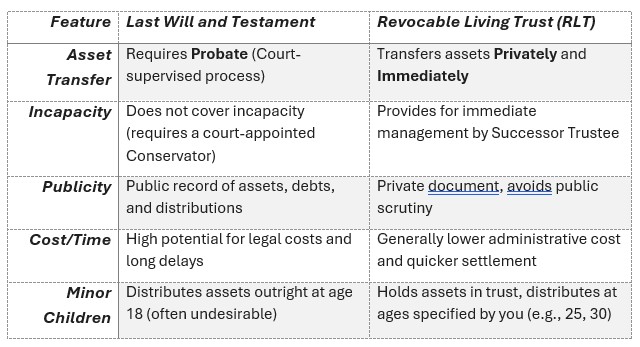
“At this stage, we have a fundamental choice in implementation, what I call The Tale of Two Documents: The Will-Based Plan versus the Trust-Based Plan.”
3.1. The Last Will and Testament: The Instructional Guide
The Will is a legal document that speaks for you only after your death and only after it has been authenticated by a court.
“The Will has three primary functions for a young family,” Professor Bear listed:
- Designating the Executor (Personal Representative): The person legally appointed to manage your estate, gather assets, pay debts, and distribute what remains.
- Distributing Assets (The Gift List): Specifying who gets which of your individually owned assets (that do not pass by beneficiary designation or joint title).
- Naming the Testamentary Guardian: This, as we discussed, is the critical appointment of the person who will raise your minor child.
The Cost of the Will: The Probate Process
Professor Bear drew a sharp distinction. “The key point you must grasp about a Will is that it is simply a set of instructions to the court. It does not transfer property by itself. Before any asset can be distributed, the Will must go through a court process called Probate.”
Probate is the formal, court-supervised legal process of proving the validity of a Will, identifying and inventorying the deceased person’s property, paying debts and taxes, and distributing the remaining assets to the beneficiaries.
“Probate is not inherently bad, but it has three distinct drawbacks that we, as planners, seek to avoid for our clients,” the Professor explained:
- Public Record: Probate is a matter of public record. Anyone, from nosey neighbors to scam artists, can go to the courthouse and find out the details of your assets, your debts, and who inherited what.
- Time and Cost: Probate is lengthy. Depending on the jurisdiction and complexity, it can take anywhere from six months to two years, freezing assets and delaying the inheritance your family needs. Legal fees, court costs, and executor fees can easily consume a significant percentage of the estate’s value – often 3% to 5% in many states, but it can be less or much more.
- No Incapacity Protection: A Will only addresses death. It offers zero protection or management for the event of incapacity (Hook #1). If you only have a Will and become incapacitated, your family still must go to court (Conservatorship or Guardianship) to manage your assets.
“So, while a Will is mandatory to name a guardian, it is an insufficient plan on its own,” he summarized.
3.2. The Revocable Living Trust: The Private Vehicle
“This brings us to the alternative: the Revocable Living Trust (RLT). This is the cornerstone of a modern estate plan for most families with real estate, significant assets, or minor children,” Professor Bear stated.
How a Trust Works
A Revocable Living Trust is a separate legal entity you create while you are alive.
- Grantor/Settlor/Trustor: You and Amelia are the Grantors – the people who create and fund the Trust.
- Trustee: You and Amelia are also the initial Trustees – the people who manage the assets placed in the Trust.
- Beneficiaries: You and Amelia are the primary Beneficiaries while you are alive. Your child(ren) and other heirs are the Successor Beneficiaries.
“Because the Trust is Revocable, you can change it, amend it, or completely abolish it at any time while you are alive and competent. And because it is Living, it is operational now,” Professor Bear explained.
The Three Trust Advantages
The Trust-based plan solves the three problems inherent in a Will-based plan:
- Avoidance of Probate (Private Succession): Upon your death, the assets owned by the Trust pass immediately and privately to the Successor Trustee, who then manages and distributes them according to the Trust’s instructions. No court, no public record, no delays.
- Seamless Incapacity Management: If either of you become incapacitated, the Trust instrument automatically allows the designated Successor Trustee to step in and manage the Trust’s assets. This avoids the need for a court-appointed Conservator.
- Protection for Minor Children: Most critically for a young family, the Trust holds assets for your child’s benefit, managed by a Trustee you choose, until an age you determine (e.g., 25, 30, 35, or in different stages), preventing an 18-year-old from receiving a massive, unmanaged lump sum.
“The Trust is the private, seamless, three-in-one planning vehicle,” Professor Bear concluded. “It handles death, incapacity, and the management of assets for your young heirs.”
Note on Pour-Over Will: Professor Bear added: “A Trust-based plan still requires a Will, which we call a Pour-Over Will. Its sole purpose is to handle any assets you failed to title into the Trust and, crucially, to formally name the Testamentary Guardian for your child. It acts as a safety net, directing any non-Trust assets through the probate court and into the existing Trust structure.”
Ch. 4 – The Four Pillars of Funding (Asset Ownership & Beneficiaries)
“We now move from the realm of documents to the realm of execution,” Professor Bear stated. “A magnificent set of legal documents – a Will, a DPOA, an AHCD, and a Trust – is nothing more than expensive paper if it doesn’t correctly interface with the assets you actually own.”
“I’ve seen this happen countless times, and it is a tragedy of planning. A client pays a substantial fee for a beautiful, custom-drafted Revocable Living Trust designed to avoid probate. They walk out of the attorney’s office with the document in hand, feeling secure.
“Two years later, they pass away. And their family discovers that their brokerage account, their house, and their main checking account were never legally retitled to the name of the Trust.”
Amelia and Ben looked at each. “Wait…what was the point of the Trust, then?” asked Ben.
“Exactly,” nodded Professor Bear. “The question becomes, What good is the Trust? And the answer, sadly, is none. If assets were not legally retitled to the name of the Trust – and instead are individually owned at the time of death – this forces the surviving family straight back into the public, costly, and time-consuming probate process.
“This hook illustrates the central truth of a successful estate plan: Title and Beneficiary Designations always trump a Will or an unfunded Trust. We call this concept the Four Pillars of Asset Transfer.”
The way an asset is titled determines its path upon your death. There are four main pathways for an asset to transfer, and only one of them is controlled by your Will or Trust.
4.1. Pillar One: Transfer by Contract (Beneficiary Designations)
“This is arguably the most powerful pillar, Ben,” the Professor said. “It bypasses all estate planning documents and the entire probate system.”
Transfer by Contract applies to assets that are legally governed by a separate contract, where you designate a beneficiary. These are called non-probate assets. Common contractual assets include:
- Retirement Accounts (IRAs, 401(k)s): You must name a Primary and Contingent Beneficiary.
- Life Insurance Policies: The death benefit is paid directly to the named beneficiary.
- Annuities: Payments are made to the named beneficiary.
- Transfer-on-Death (TOD) / Pay-on-Death (POD) Accounts: Many states allow bank and brokerage accounts, and even vehicles, to have a TOD/POD designation.
“When you pass away, the custodian (the bank, the insurance company) simply looks at the beneficiary form you signed and pays the asset to that person. It is fast, private, and efficient. It is critical that your financial advisor reviews these designations periodically,” Professor Bear stressed.
“The most common mistake young couples make is naming each other as Primary, which is fine, but then naming their minor child as the Contingent Beneficiary,” Amelia noted.
“Precisely. If you both perish simultaneously, the insurance company pays the multi-hundred-thousand-dollar death benefit directly to a minor,” the Professor explained. “Since a minor cannot legally own significant assets, a court-supervised Guardianship of the Estate must be created, often requiring expensive legal fees and mandatory court oversight until the child turns 18. The solution is to name your Revocable Living Trust as the contingent beneficiary.”
By doing this, if you both pass, the funds flow directly into the Trust, which contains the detailed, professional instructions you created for how and when the funds should be managed and distributed to your child (e.g., used for health care, necessary support, and education, with the majority of the distribution occurring at later ages, such as 30 and 35).
4.2. Pillar Two: Transfer by Title (Joint Ownership)
Certain assets are owned with another person and pass automatically to the surviving owner upon the first owner’s death. This also bypasses probate and the Will.
- Joint Tenancy with Right of Survivorship (JTWROS): If Ben and Amelia own their primary residence JTWROS, when Ben passes, Amelia automatically owns the entire property, and vice versa.
- Tenancy by the Entirety (TBE): A form of ownership similar to JTWROS, but only available to married couples in some states, offering creditor protection.
“Joint ownership sounds simple, but it is often a poor substitute for a comprehensive plan,” Professor Bear warned. “First, it doesn’t cover simultaneous death. Second, the surviving owner gains complete, unmanaged control of the asset, which is typically fine for a spouse, but can be disastrous if it’s a vulnerable or unwise child.”
4.3. Pillar Three: Transfer by Operation of Law (Intestacy)
“This is the pillar of absolute failure,” the Professor sighed. “Intestacy occurs when you die without a valid Will or Trust, and you have failed to use Pillars One or Two for a given asset.”
When this happens, the state’s default rules of succession – its “intestacy statutes” – determine who inherits.
“Your state has a simple flowchart for who gets your assets,” Professor Bear said. “In most cases, for a married couple with one child, the spouse gets a portion, and the child gets a portion, often causing marital friction and requiring a costly, court-supervised Guardianship for the child’s share. The state has created a default estate plan for you – but it’s one you almost certainly hate.”
4.4. Pillar Four: Transfer by Document (Trust Funding)
“This is the pathway we want to control,” Professor Bear proclaimed. “Assets titled in the name of your Revocable Living Trust are governed by the Trust documents.”
“A Trust only governs the assets titled in its name,” the Professor reiterated. “If you sign the Trust but never change the title on your home from ‘Ben and Amelia Smith’ to ‘Ben Smith and Amelia Smith, Co-Trustees of The Smith Family Trust dated [Date],’ the house is not in the Trust. It must still go through probate.”
The Funding Checklist:
- Real Estate: Execute a new deed transferring ownership into the Trust.
- Bank/Brokerage Accounts: Change the registration on the account title to the name of the Trust.
- Business Interests: Transfer LLC or corporate shares into the Trust.
“The role of your financial advisor and the estate planning attorney is to coordinate this funding process. Your advisor, Sarah, is essential for retitling the non-retirement investment accounts and ensuring the beneficiary designations (Pillar One) are correctly pointed toward the Trust,” Professor Bear emphasized.
Ch. 5 – Your Financial Advisor: The Quarterback of Your Plan
“The final piece of our discussion, Amelia and Ben, addresses a critical component in executing and maintaining your estate plan: the indispensable role of your personal financial advisor,” Professor Bear said, picking up a pen.
“I am an attorney. I draft the blueprints and sign the documents. Sarah is the financial quarterback who handles the assets, ensures the structure works, and provides protection for you during your lifetime.”
5.1. The Collaboration: Legal Structure Meets Financial Reality
The estate plan requires a deep partnership between your legal counsel and your financial team.
“In this partnership, Sarah’s primary job is to ensure that the four pillars of asset transfer align perfectly with the legal structure I create,” the Professor explained. “Her and I will work together to make sure that everything is properly titled and assigned. We will also help you through any paperwork that you need to complete.”
Financial Advisor’s Responsibilities in the Estate Planning Process:
- Funding Oversight: The advisor monitors and assists with the physical retitling of accounts into your new Revocable Living Trust. They ensure the Trust is funded.
- Beneficiary Review: They routinely review and update your contractual beneficiary designations to ensure they align with the Trust’s ultimate distribution plan (e.g., naming the Trust as the contingent beneficiary for your 401(k)).
- Documentation Communication: When you execute a DPOA, Sarah needs a copy. When you title assets into the Trust, she needs the Trust Certification. This ensures she knows exactly who has the legal authority to act on your behalf, minimizing friction during an incapacity event.
- Annual Review: A great advisor will schedule regular check-ins to review your plan because your life, laws, and assets are constantly changing. These reviews help identify any life events or laws that may impact your estate planning or financial needs, as well as ensure that all of your beneficiary designations are properly assigned. It is also a great opportunity to talk through potential scenarios you may be facing, such as a job change, upcoming move, or changes to family dynamics.
5.2. The Fiduciary Shield: Trusted Contact Person (TCP)
Professor Bear then introduced a relatively new but essential protection provided by the financial industry.
“Let’s return to the threat of incapacity, but let’s change the source,” prompted the Professor. “Imagine, Ben, that you begin showing signs of cognitive decline or confusion. Perhaps you start making unusual, high-risk trades, or you tell Sarah you need to urgently send a large wire transfer to a stranger you met online. You are still legally competent, but Sarah sees clear ‘red flags’ – a silent signal of vulnerability.”
Amelia looked at Ben, perplexed. It wasn’t an unheard-of scenario, but she’d never imagined it happening to them.
“The question is: Who can Sarah call?” The professor paused, letting the question sink in.
“Wouldn’t she call me?” asked Amelia.
Professor bear turned to Amelia. “What if you, too, also showed these signs? Or were at the very least unsure about what to do? Or what if it was an account that only Ben had the authority to act upon?”
Amelia’s eyes got wide. Both of us? She thought. It couldn’t possibly…
Sensing her train of thought, Professor Bear’s face softened. “It can happen – and in fact, it has, to many people, who assume they are doing the right thing when in fact they are facing a scam or, potentially, a serious but undiagnosed medical condition. And in this scenario, Sarah cannot call your family, because federal and state privacy rules strictly govern who she can discuss your account with. Without your express permission, her hands are tied. She is legally obligated to protect your privacy, even if it means watching you lose your assets to exploitation.
“This is why, thanks to regulations introduced by FINRA (the Financial Industry Regulatory Authority), financial firms like Scholar Financial are required to ask you to name a Trusted Contact Person (TCP) on your account forms.”
The Role of the Trusted Contact Person
A TCP is an individual (age 18 or older) whom you authorize your financial advisor to contact and disclose information about your account, but only in very limited circumstances.
Why the Advisor Needs the TCP:
- Financial Exploitation: To address concerns that you might be a victim of fraud, coercion, or financial exploitation.
- Contact/Health Confirmation: If your advisor cannot reach you, the TCP can confirm your current contact information or health status.
- Verification of Authority: To confirm the identity of any legal guardian, executor, trustee, or holder of your Power of Attorney.
Crucially, the TCP is NOT an Agent.
“Amelia, please understand: Naming a TCP does not give that person any authority to transact business, access your account, or make decisions about your investments. Their role is purely to be a resource for your advisor to protect your assets when you are in trouble or incommunicado,” Professor Bear asserted.
“The TCP is your first line of defense against the silent signal of vulnerability. Your financial advisor should be the one to guide you through filling out and submitting these forms, as they understand the operational compliance and the necessary communication protocols better than anyone else.”
Conclusion: The First Steps for the Smith Family
Professor Bear pushed the final documents across the table – a complete, organized binder containing the templates for their estate plan.
“Ben, Amelia, congratulations on starting this journey. You are giving your child – and yourselves – a tremendous gift: the gift of clarity and protection.”
He summarized the necessary action points for them:
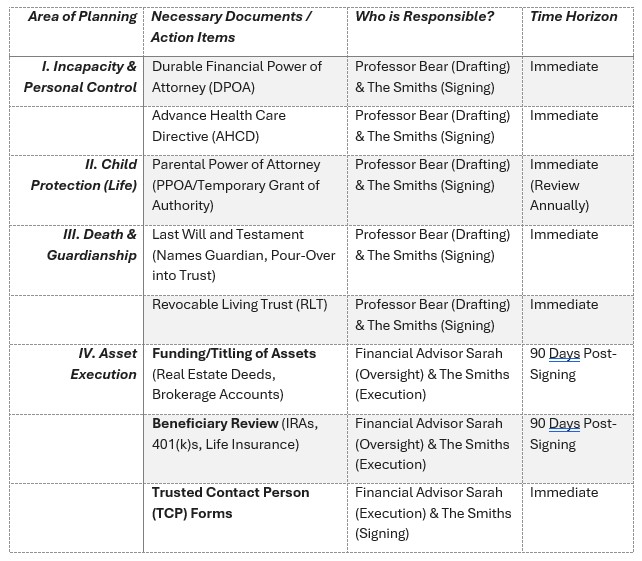
“Estate planning is not a product you buy; it’s a process you maintain,” the Professor concluded, standing to shake their hands. “Your plan is now created, but the work – the funding and the annual review – has just begun. Work closely with Sarah. She will be your continuous guide, ensuring the paper plan perfectly reflects your financial reality and the love you have for the little one you are about to welcome.”


