
Will a Lifetime of Tax Deferral Lead to a Tax Nightmare in Retirement?
The Decumulation Dilemma for America’s Professors
by Chris Brown, PhD, CFP® and Ron A. Rhoades, JD, CFP®
What if the very strategy that built your retirement wealth cost you hundreds of thousands of dollars in taxes that you never saw coming?
For decades, the standard financial advice has been to maximize contributions to tax-deferred retirement accounts – the 403(b), the 401(k), and unique academic vehicles like the TIAA Traditional Annuity. This strategy, highly effective during the accumulation phase, allows professors to defer taxes, benefit from immediate tax deductions, and watch their savings compound powerfully over time. For many academics, it has worked spectacularly well.
However, for a professor aged 50 or older, the focus must shift from accumulation to decumulation, and the large balances in those tax-deferred accounts can become a formidable tax liability. This liability can trigger a cascade of adverse effects in retirement, including surprisingly high marginal tax rates, reduced healthcare subsidies, and the notorious “tax torpedo” that targets Social Security benefits. Research from the TIAA Institute confirms that optimal withdrawal sequencing can add meaningful value to retirement outcomes, while Vanguard research emphasizes that paying taxes during lower-income years – rather than deferring indefinitely – often yields superior lifetime results.[1]
The art of retirement income generation lies in strategically sequencing withdrawals from three distinct buckets – Taxable, Tax-Deferred, and Tax-Free – to minimize the lifetime tax burden. Get it right, and you preserve significantly more of your life’s savings. Get it wrong, and you may watch the IRS claim a disproportionate share of what you spent decades accumulating.
Professor Eleanor Vance and the Looming Tax Torpedo
Could a successful savings strategy push Eleanor into a 44% effective tax bracket – nearly double what she expects?
Chris and Ron, two CFP® professionals at Scholar Financial well versed in the financial complexities of academic life, sat down with a new prospective client, Dr. Eleanor Vance, a 62-year-old tenured History Professor at a major university. Eleanor, recently widowed, was planning to retire next year with a substantial portfolio.
“Dr. Vance, your savings are excellent,” Chris began, reviewing her financial model. “$2.7 million saved, with 88% in pre-tax vehicles: the university 403(b), a TIAA Traditional contract, and a small rollover IRA. The remaining 12% is split between a taxable brokerage account and a small Roth IRA.”
“However,” Ron interjected, pointing to a graph that projected Eleanor’s marginal tax rate climbing sharply after age 73, “if we follow a non-optimized strategy – say, simply withdrawing money as needed – the Required Minimum Distributions (RMDs) from your $2.37 million in tax-deferred accounts will trigger a substantial tax event. We project you will be forced into the 32% marginal tax bracket during your late 70s and 80s.”
This is the central dilemma for many professors: the cumulative success of tax deferral pushes their retirement accounts to levels that necessitate large, unavoidable, taxable RMDs. Under the SECURE 2.0 Act of 2022, the RMD starting age is now age 73 for individuals born between 1951 and 1959; that age increases to 75 for those born in 1960 or later – providing additional planning opportunities for proactive academics.[2] The key to managing this lies in the strategic withdrawal order and aggressive planning during the pre-RMD years.
What is the Optimal Order to Withdraw Funds to Flatten Your Tax Rate?
What if the conventional wisdom about withdrawal order is fundamentally wrong for high-balance savers?
Decades of research have explored optimal withdrawal sequencing, challenging the simplistic notion of Taxable → Tax-Deferred → Tax-Free. The consensus among academics and financial economists now favors an adaptive strategy that prioritizes income smoothing – strategically managing taxable income year by year to minimize lifetime taxes.[3]
Phase I: The “Tax Control” Years (Retirement to RMD Age)
For professors retiring between ages 60 and 72, this is the most critical window for tax mitigation. With the SECURE 2.0 Act having delayed the RMD age to 73 (and 75 for those born in 1960 or later), retirees now have an extended opportunity to execute tax-efficient strategies before mandatory distributions begin.[4]
Filling the Brackets with Roth Conversions: With most of Eleanor’s income sources – her Social Security retirement benefit (delayed until 70 in her case) and her RMDs – not yet active, her taxable income floor is low. This creates a strategic opportunity to “harvest” the lower tax brackets (10%, 12%, or 22%) by executing Roth IRA conversions.
“We can convert $75,000 from your 403(b) to a Roth each year for the next six years,” Chris explained. “This uses up your 22% and a portion of your 24% tax bracket today but moves over half a million dollars permanently out of the RMD calculation and the tax system entirely. The consensus among financial economists is that paying taxes now, when rates are potentially lower and tax control is greatest, hedges against the risk of unknown future tax rate increases and RMD shock.”
Research confirms that small, strategic Roth conversions in early retirement may increase after-tax wealth by approximately 10-15% through reduced income taxes, lower Medicare premiums, and preserved tax credits.[5]
Funding the Conversion Tax: Ideally, the tax bill generated by the Roth conversion should be paid using funds from the Taxable Brokerage Account. Paying the tax from the traditional retirement account reduces the amount converted, making the strategy less efficient; still, such can be a valid strategy if one’s marginal income tax rate is lower at the time of the conversion that it would be later. In contrast, paying the tax generated by the conversion from the taxable account effectively shifts tax-inefficient wealth into a perpetually tax-free environment.[6]
Initial Withdrawal Order Adaptation: Should Eleanor need income for living expenses before RMDs begin, a modified withdrawal order is usually best. First, the Taxable Account should be used strategically to cover living expenses, prioritizing the sale of assets with long-term, low capital gains or those that can be sold near cost basis. Second, the Tax-Deferred Account (403(b)/IRA) should be used to “fill” the lower tax brackets, either for living expenses or for the Roth conversion strategy. Third, the Roth Account should be left to grow untouched, maximizing the benefit of tax-free compounding.
Phase II: The RMD Years and Income Smoothing
Once RMDs begin, the professor’s income is largely dictated by IRS mortality tables. For a large portfolio, this income can easily push the retiree into a higher marginal tax bracket – a reality that makes pre-RMD planning essential.
The Power of Qualified Charitable Distributions (QCDs): For charitably inclined professors, the Qualified Charitable Distribution becomes an indispensable tool after age 70½. QCDs allow individuals to transfer up to $111,000 in 2026 (indexed annually for inflation) directly from an IRA to a qualified charity.[7] This transfer satisfies all or part of the RMD requirement without the money ever entering the professor’s Adjusted Gross Income.[8] Importantly, QCDs can begin at age 70½, even before RMDs are required, providing early planning opportunities.
“Eleanor, if you’re planning to give $15,000 annually to your alma mater,” Ron explained, “doing so through a QCD rather than writing a check could save you approximately $3,500 in federal taxes each year – money that stays in your portfolio working for you.”
The Strategic Withdrawal Order After RMDs Begin: Once RMDs are satisfied, any additional spending should generally follow a strict order to preserve the longest-term tax-free growth: Taxable → Tax-Deferred (above RMD) → Roth 401(k)/403(b) → Roth IRA. The permanent removal of RMDs on Roth 401(k)s and 403(b)s by SECURE 2.0, effective in 2024, makes these accounts equally powerful as Roth IRAs for income generation and wealth transfer.[9]
How Do Your Withdrawal Decisions Create the Social Security and Medicare “Tax Trap”?
How can one extra dollar of retirement income trigger $1.85 in taxable income?
The complexity of retirement taxes stems not just from income tax rates, but from a dramatic increase in effective marginal tax rates caused by the interaction of taxable income with Social Security benefits and Medicare premiums.
The Social Security Tax Torpedo
The most insidious of these traps is the Social Security Tax Torpedo. When a retiree’s “Provisional Income” (which equals Adjusted Gross Income + Tax-Exempt Interest + 50% of Social Security benefits) exceeds certain static thresholds, 50% or even 85% of their Social Security benefit becomes taxable. These thresholds – $25,000 for single filers and $32,000 for joint filers for the 50% tier, and $34,000/$44,000 for the 85% tier – have never been adjusted for inflation since their enactment.[10]
In the phase-in ranges, every $1 of additional taxable income from a 403(b) withdrawal can increase the retiree’s total taxable income by up to $1.85 (when the 85% inclusion rule applies). According to T. Rowe Price research, some retirees in the 22% federal tax bracket could face an effective marginal tax rate as high as 40.7% because additional household income causes more of their Social Security income to become taxable.[11] For Eleanor, nominally in the 24% federal tax bracket, this could mean an effective marginal tax rate near 44% on marginal dollars of RMD-driven income. This makes the strategic deployment of Roth conversions during the low-income years a powerful defense against the torpedo later on. Note, however, that the “tax torpedo” no longer applies after a taxpayer’s income is sufficient to make the Social Security income 85% taxable.
IRMAA: The Medicare Premium Cliffs
Medicare Part B and Part D premiums are determined by the Income-Related Monthly Adjustment Amount (IRMAA), which is based on Modified Adjusted Gross Income (MAGI) from two years prior. For 2026, IRMAA surcharges begin at $109,000 for single filers and $218,000 for married couples filing jointly (based on 2024 income). The standard Part B premium rises to $202.90 monthly, but high-income beneficiaries can pay up to $689.90 per month.[12]
IRMAA operates as a series of “cliffs” where crossing a certain MAGI threshold by even $1 can dramatically increase annual premium surcharges for both Part B and Part D. For a married couple filing jointly, exceeding the first threshold can cost an additional $1,900 or more annually in Medicare premiums.
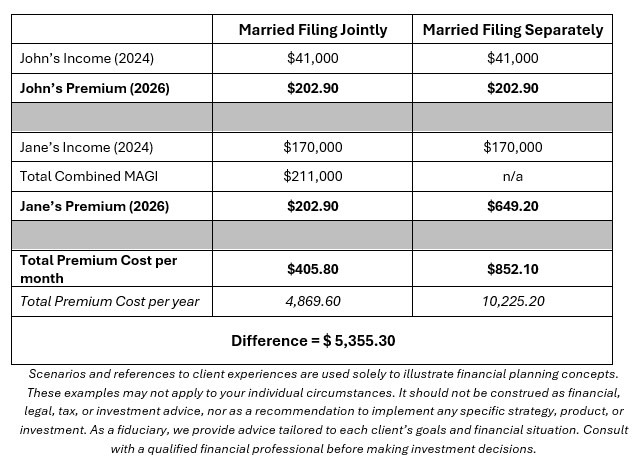
IRMAA is especially punitive for married couples filing separately. For example, John and Jane Bettersworth are paying for Medicate Part B. John’s MAGI is $41,000 per year, and Jane’s is $30,000 per year. For 2024, they opted to file as “married filing separately” because Jane inherited and sold a property worth $140,000. Since John’s income was less than $109,000, his Medicare Part B premium for 2026 is $202.90. However, because Jane received a premium based on her income of $170,000 (in 2024), her Medicare Part B premium is $649.20.[13] In total, John and Jane are paying $852.10 a month in premiums.
If John and Jane had filed their 2024 taxes jointly, with a MAGI of $211,000, they would have fallen in the first IRMAA cliff – and they would be paying $202.90 each per month, for a total of $405.80/month – or $4,869.60 annually. Instead, because they filed their 2024 taxes as “married filing separately,” they are paying $202.90 + $649.20 = $852.10/month, or $10,225.20. That’s a difference of $5,355.30!
The Planning Angle: Because Roth withdrawals and Qualified Charitable Distributions do not count toward MAGI, they are the ideal source of supplemental retirement income when a professor is near an IRMAA cliff. Chris and Ron meticulously modeled Eleanor’s Roth conversion strategy to keep her MAGI below the first IRMAA bracket threshold in 2026, preventing an unnecessary healthcare cost surcharge of over $2,000 annually.[14]
For Some, Consider Filing Form SSA-44. Medicare beneficiaries who have recently retired or experienced a work reduction may be able to lower their Income-Related Monthly Adjustment Amount (IRMAA) by requesting a review based on a more recent income year. This is accomplished by filing SSA Form-44, the Medicare Income-Related Monthly Adjustment Amount – Life-Changing Event form, with the Social Security Administration. Since IRMAA is typically determined using income data from two years prior (e.g., 2026 IRMAA uses 2024 tax data), filing Form SSA-44 allows the Social Security Administration (SSA) to consider the most recent year’s income if a qualifying life-changing event, such as work stoppage or reduction, has occurred.
Can Your Investment Choices Further Enhance Tax Efficiency?
Could simply moving the same investments to different accounts add meaningful returns over your retirement?
Yes. The intentional placement of specific asset classes into different accounts, known as Asset Location, is a powerful, yet often overlooked, strategic decision that can enhance after-tax returns over a retirement horizon. Research from Schwab indicates that for retirees in higher tax brackets, approximately 90% of the potential extra return from asset location comes from just two specific moves: (1) using municipal bonds instead of taxable bonds in taxable accounts, and (2) holding tax-efficient exchange-traded funds (ETFs) in taxable accounts while keeping less tax-efficient investments in tax-advantaged accounts.[15]
The Principles of Tax-Efficient Asset Location
Tax-Deferred Accounts (403(b), IRA): These accounts are best suited for assets that generate ordinary income or frequent short-term gains, which are tax-inefficient. Taxable bonds, certain stock funds, REITs, and TIAA Traditional contracts belong here because placing them shields annual income from current taxation.[16]
Tax-Free Accounts (Roth IRA/401(k)): Investments with the highest potential rate of return and capital appreciation should be placed here, as all future growth and withdrawals are permanently tax-free. High-growth equities, such as small-cap value funds, can maximize the value of the Roth’s tax-free status.[17]
Taxable Brokerage Accounts: Tax-efficient ETFs, municipal bonds, and low-turnover index funds are appropriate here. Municipal bonds generate federally tax-exempt income (and often state-exempt income for residents), while index ETFs minimize annual capital gains distributions. Long-term gains in taxable accounts are taxed at favorable rates of 0%, 15%, or 20% depending on income.[18] Foreign stock funds and ETFs are often placed in taxable brokerage accounts, to obtain foreign tax credits or deductions.
The ETF Advantage and Capital Gains Management
For taxable accounts, the choice between a mutual fund and an Exchange-Traded Fund (ETF) can have a significant tax impact. Traditional actively managed mutual funds must often sell appreciated securities to meet shareholder redemptions, leading to annual capital gains distributions that are passed to all shareholders – even those who didn’t sell any shares.
ETFs, due to their unique “in-kind” creation and redemption process with Authorized Participants, rarely distribute capital gains, making them substantially more tax-efficient for taxable accounts. According to State Street Global Advisors research, in 2024, only 5% of all ETFs distributed capital gains compared to 43% of mutual funds – a dramatic difference that compounds over time.[19] This structural advantage allows professors to retain control over when capital gains are realized.
Tax-Loss Harvesting: Turning Market Volatility into Opportunity
In the taxable account, a professor can sell an investment currently at a loss to offset realized capital gains elsewhere in the portfolio. Under IRS rules, any remaining net capital loss can be used to offset up to $3,000 in ordinary income annually ($1,500 if married filing separately), with unused losses carrying forward indefinitely to future tax years.[20] This ongoing risk-management strategy is particularly vital during the early retirement years when market volatility is high and income flexibility is greatest.
“Eleanor, when the market dropped 15% in the first quarter,” Chris noted, “we harvested $22,000 in losses from your international fund, reinvested in a similar but not identical fund to maintain your allocation, and now have those losses available to offset gains for years to come – all while keeping your investment strategy intact.”
What are the Tax Implications of TIAA Traditional Withdrawals?
Your TIAA Traditional account may be your most reliable income source – but it requires careful integration into your overall tax strategy.
The cornerstone of many academic retirement plans, the TIAA Traditional account must be integrated into the overall decumulation strategy.
TIAA Traditional (Pre-Tax): The TIAA Traditional contract is typically funded with pre-tax dollars within a 403(b) plan, making all withdrawals – whether systematic withdrawals, transfers, or annuitized payments – taxable as ordinary income. This makes the TIAA Traditional functionally similar to a traditional IRA or 403(b) for tax purposes.[21]
Decumulation Strategy: Given that payments from TIAA Traditional are guaranteed and taxed as ordinary income, they are best utilized to provide the income floor that satisfies basic living expenses. The withdrawals should be carefully modeled alongside RMDs to ensure they do not unnecessarily push the professor into a higher tax bracket. For Eleanor, it was worth exploring the option of strategically annuitizing a portion of her TIAA Traditional to create predictable, level ordinary income that made her RMD and Roth conversion planning more precise.
Conclusion: The Professor’s After-Tax Advantage
The shift from accumulation to decumulation marks a profound transition in financial strategy. For Dr. Vance, and for thousands of other professors approaching or entering retirement, the goal is clear: leverage the period of maximal tax control (the pre-RMD years) to proactively reduce the tax liability of the post-RMD future.
Six months into working with Scholar Financial, Eleanor’s projected lifetime tax savings were substantial. More importantly, she had peace of mind knowing her withdrawal strategy was coordinated across all her accounts, her Social Security claiming decision was optimized, and her Medicare premium exposure was minimized.
As Ron concluded, “The challenge is that the tax system penalizes the uncoordinated plan. By orchestrating a sequence of strategic Roth conversions, utilizing QCDs, and maintaining surgical precision around your MAGI to avoid IRMAA cliffs and the Social Security torpedo, we don’t just reduce your tax bill; we fundamentally increase the purchasing power and longevity of your life’s work. It’s about ensuring the government only receives its fair share – not a tax penalty for your success.”
Is your retirement plan optimized for tax efficiency?
Schedule a complimentary consultation with Scholar Financial to discover how much you could save.
This article is for educational purposes only. Scenarios and references to client experiences are used solely to illustrate financial planning concepts. Dr. Eleanor Vance is a hypothetical client and is not directly representative of any current client of Scholar Financial of XYPN Sapphire. These examples may not apply to your individual circumstances. It should not be construed as financial, legal, tax, or investment advice, nor as a recommendation to implement any specific strategy, product, or investment. As a fiduciary, we provide advice tailored to each client’s goals and financial situation. Consult with a qualified financial professional before making investment decisions.
Prices, values, and other data are obtained from sources deemed reliable at the time of use, but accuracy is not guaranteed.
Advisory services are offered through XYPN Sapphire and its various IAR brands under which it operates. XYPN Sapphire is an SEC registered investment adviser. For additional disclosure and privacy information, please visit XYPNSapphire.com/disclosures.
Endnotes
- TIAA Institute, 2017; Vanguard, 2022
- Fidelity, 2025; Ascensus, 2025
- Schwab, 2025; Kiplinger, 2025
- IRS, 2025; Kiplinger, 2025
- UBS, 2025; Vanguard, 2025
- Schwab, 2025; Vanguard, 2025
- Dixon, Amanda and Patrick Villanova. “All About Qualified Charitable Distributions.” SmartAsset.com https://smartasset.com/retirement/all-about-qualified-charitable-distributions
- Fidelity Charitable, 2025; Schwab, 2025
- Fidelity, 2025; Ascensus, 2025
- Kiplinger, 2025; T. Rowe Price, 2025
- T. Rowe Price, 2025; Congressional Research Service, 2025
- Kiplinger, 2025; NerdWallet, 2025
- See Fact Sheet: 2026 Medicare Costs at https://www.medicare.gov/publications/11579-medicare-costs.pdf
- Medicareresources.org, 2025; Kiplinger, 2025
- Schwab, 2025; BlackRock, 2025
- T. Rowe Price, 2025; Fidelity, 2025
- Schwab, 2025; Fidelity, 2025
- BlackRock, 2025; Vanguard, 2025
- State Street Global Advisors, 2025; J.P. Morgan, 2025
- IRS Topic 409, 2025; Schwab, 2025
- TIAA, 2025
References
Ascensus. (2025). SECURE 2.0 Act changes RMD rules. Retrieved from https://www.ascensus.com/industry-regulatory-news/news-articles/secure-2-0-act-changes-rmd-rules/
BlackRock. (2025). Tax efficient asset location. Retrieved from https://www.blackrock.com/us/financial-professionals/insights/asset-location-for-tax-efficient-investing-financial-advisors
Congressional Research Service. (2025). Taxation of Social Security benefits and the senior deduction (Report No. R48613). Retrieved from https://www.congress.gov/crs-product/R48613
Fidelity. (2025). Secure Act 2.0: What the new legislation could mean for you. Retrieved from https://www.fidelity.com/learning-center/personal-finance/secure-act-2
Fidelity. (2025). Asset location: Investing in the right accounts. Retrieved from https://www.fidelity.com/viewpoints/investing-ideas/asset-location-lower-taxes
Fidelity Charitable. (2025). Qualified charitable distribution. Retrieved from https://www.fidelitycharitable.org/guidance/philanthropy/qualified-charitable-distribution.html
Internal Revenue Service. (2025). Retirement plan and IRA required minimum distributions FAQs. Retrieved from https://www.irs.gov/retirement-plans/retirement-plan-and-ira-required-minimum-distributions-faqs
Internal Revenue Service. (2025). Topic no. 409, Capital gains and losses. Retrieved from https://www.irs.gov/taxtopics/tc409
J.P. Morgan Asset Management. (2025). Tax efficiency of ETFs. Retrieved from https://am.jpmorgan.com/us/en/asset-management/adv/insights/etf-insights/tax-efficiency-of-etfs/
Kiplinger. (2025). How to calculate taxes on Social Security benefits. Retrieved from https://www.kiplinger.com/retirement/social-security/604321/taxes-on-social-security-benefits
Kiplinger. (2025). Medicare premiums 2026: IRMAA brackets and surcharges for Parts B and D. Retrieved from https://www.kiplinger.com/retirement/medicare/medicare-premiums-projected-irmaa-for-parts-b-and-d-for-2026
Kiplinger. (2025). New RMD rules: Starting age, penalties, Roth 401(k)s, and more. Retrieved from https://www.kiplinger.com/retirement/new-rmd-rules
Medicareresources.org. (2025). What is the income-related monthly adjusted amount (IRMAA)? Retrieved from https://www.medicareresources.org/medicare-eligibility-and-enrollment/what-is-the-income-related-monthly-adjusted-amount-irmaa/
NerdWallet. (2025). IRMAA brackets 2025-2026: What they are and how they work. Retrieved from https://www.nerdwallet.com/article/insurance/medicare/what-is-the-medicare-irmaa
Charles Schwab. (2025). How asset location can help save on taxes. Retrieved from https://www.schwab.com/learn/story/how-asset-location-can-help-save-on-taxes
Charles Schwab. (2025). Reducing RMDs with QCDs in 2025 and 2026. Retrieved from https://www.schwab.com/learn/story/reducing-rmds-with-qcds
Charles Schwab. (2025). How to cut your tax bill with tax-loss harvesting. Retrieved from https://www.schwab.com/learn/story/how-to-cut-your-tax-bill-with-tax-loss-harvesting
State Street Global Advisors. (2025). ETFs and tax efficiency: What you need to know. Retrieved from https://www.ssga.com/us/en/individual/resources/education/etfs-and-tax-efficiency-what-you-need-to-know
- Rowe Price. (2025). What to know about Social Security benefits and your taxes. Retrieved from https://www.troweprice.com/personal-investing/resources/insights/the-impact-of-social-security-benefits-on-your-taxes.html
- Rowe Price. (2025). Asset location can play a key role in tax-efficient investing. Retrieved from https://www.troweprice.com/financial-intermediary/us/en/insights/articles/2025/q3/asset-location-can-play-a-key-role-in-tax-efficient-investing.html
TIAA. (2025). TIAA Traditional Annuity: Understanding your guaranteed income options. Retrieved from https://www.tiaa.org/public/pdf/brochures/tiaa_traditional_annuity.pdf
TIAA Institute. (2017). Tax-efficient sequencing of accounts to tap in retirement. TIAA Institute Research Dialogue.
UBS. (2025). Should 401(k) millionaires consider a Roth conversion? Retrieved from https://www.ubs.com/us/en/wealth-management/insights/market-news/article.2915103.html
Vanguard. (2022). A ‘BETR’ approach to Roth conversions. Vanguard Research.
Vanguard. (2025). Is a Roth IRA conversion right for you? Retrieved from https://investor.vanguard.com/investor-resources-education/iras/ira-roth-conversion
Vanguard. (2025). How to take qualified charitable distributions (QCD). Retrieved from https://investor.vanguard.com/investor-resources-education/faqs/how-do-i-take-a-qualified-charitable-distribution-qcd


