
Is Sleep the Foundation of Student Learning and Success?
by Dr. Ron A. Rhoades, JD, CFP®
Introduction: A Silent Crisis in Higher Education
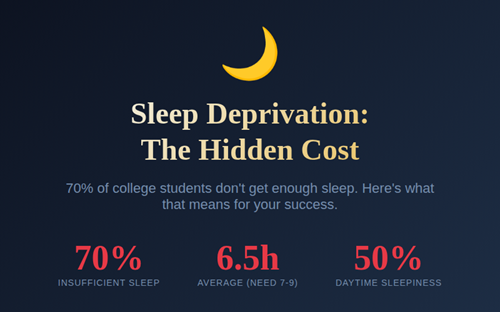
In classrooms across the nation, faculty face a paradox: students have unprecedented access to educational resources yet struggle to absorb and retain information. Behind glazed eyes and sluggish participation often lies a common culprit – sleep deprivation. Research reveals that approximately 70% of college students obtain insufficient sleep, with the average college student sleeping only 6.5 hours per night – nearly one-third less than the recommended 7–9 hours for young adults (Hershner & Chervin, 2014; Creswell et al., 2023).
By comparison, approximately 65% of adults in the general U.S. population report getting 7 or more hours of sleep (CDC, 2016). College students face unique challenges: new independence, competing social and academic demands, and biological factors that make them particularly vulnerable to sleep deprivation. Multiple studies report that roughly 50% of college students experience excessive daytime sleepiness, higher than the rates observed in many community adult samples (Hershner & Chervin, 2014).
As educators, we hold unique influence over factors that either support or undermine student sleep. From assignment deadlines to course scheduling to the messages we convey about all-nighters, our choices ripple through students’ lives. This article synthesizes the latest research on sleep and academic success, offering evidence-based strategies for faculty who wish to promote student well-being and learning.
How Much Sleep Do College Students Need?
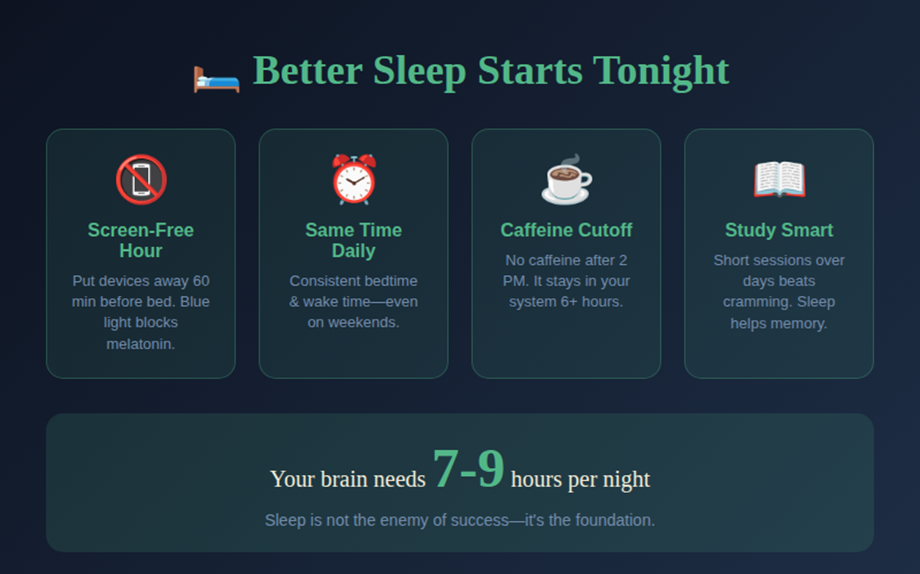
The National Sleep Foundation and American Academy of Sleep Medicine have reached consensus: young adults aged 18–25 require 7–9 hours of sleep per night, while teenagers 13–17 need 8–10 hours (Hirshkowitz et al., 2015; Watson et al., 2015). Some experts suggest that optimal functioning for young adults may require up to 9.25 hours per night (Wolgast, 2024). Yet studies consistently show that the average college student obtains only 6.25–6.5 hours on weeknights. Research across multiple samples using both self-report and actigraphy indicates that 70–96% of college students regularly obtain fewer than 8 hours per night (Hershner & Chervin, 2014; Creswell et al., 2023).
This sleep deficit is not merely a matter of poor time management. Biological factors – particularly the circadian rhythm changes that occur during adolescence and young adulthood – play a significant role in why college students are uniquely vulnerable to sleep deprivation.
The Circadian Rhythm: Why College Students are Biologically Programmed to Stay Up Late
The circadian rhythm is an internal biological clock that regulates sleep–wake cycles, hormone release, body temperature, and cognitive performance over a roughly 24-hour period. This rhythm is primarily controlled by the suprachiasmatic nucleus in the brain’s hypothalamus and is synchronized by environmental cues, particularly light exposure (Crowley et al., 2007).
During puberty, a dramatic biological shift occurs: adolescents and young adults experience a 1–4 hour delay in their circadian timing (Hagenauer et al., 2009). This delay is not a choice or a character flaw – it is driven by pubertal hormones and changes in the fundamental properties of the circadian system. Research shows that the typical adult circadian period is approximately 24.1 hours, with individual variation; adolescents show a slightly longer period on average in some studies, which can make it easier for bedtime to shift later (Hershner & Chervin, 2014). The melatonin release that signals sleepiness occurs later in the evening for young adults, making it biologically difficult for them to fall asleep at traditional bedtimes.
This phenomenon has been observed across multiple mammalian species, not just humans, and laboratory studies confirm the delay persists even when social influences are controlled (Hagenauer et al., 2009; Crowley et al., 2007). The shift toward evening chronotype (“night owl” tendencies) occurs during late adolescence and young adulthood and gradually reverses as individuals move into their mid-20s and beyond (Roenneberg et al., 2004).
The Prevalence of Delayed Sleep Patterns
Research indicates that evening chronotypes are prevalent among college students. One study found that 28.6% of college students were classified as evening types compared to 12.7% as morning types (Li et al., 2020). Evening chronotypes show poorer sleep quality (20.2% vs. 9.6% for morning types), greater daytime sleepiness, and higher risk for depression and anxiety (Li et al., 2020). A large epidemiological study found that males show more extreme changes in chronotype across adolescence than females (Roenneberg et al., 2004).
When students with evening chronotypes are forced to attend early morning classes, they experience circadian misalignment – their internal clock signals “sleep” while their alarm clock signals “wake up.” A UC Berkeley study analyzing 3.4 million learning management system logins found that students whose circadian rhythms were more misaligned with their class schedules were associated with lower grades (Smarr & Schirmer, 2018).
The Neuroscience of Sleep and Learning
Sleep is not merely rest – it is an active process essential for learning. A landmark study by Okano et al. (2019) found that sleep quality, duration, and consistency accounted for approximately 25% of variance in academic performance. Most striking: sleep during the week before an exam was a stronger predictor of test performance than sleep the night immediately before.
During deep sleep, memories formed during waking hours are reactivated through hippocampal replay, transferring to the neocortex for long-term storage (Walker, 2017). When students sacrifice sleep, they short-circuit this consolidation process, effectively studying information their brains cannot retain.
The Sleep–GPA Connection: What the Research Shows
A groundbreaking 2023 study published in the Proceedings of the National Academy of Sciences (PNAS) tracked first-year students across three universities (Carnegie Mellon, University of Notre Dame, and University of Washington) using wrist actigraphy to objectively measure sleep. The findings were striking: every additional hour of average nightly sleep duration early in the semester was associated with a 0.07 increase in end-of-term GPA. Importantly, this association persisted even after controlling for previous-term GPA, daytime napping, race, gender, first-generation status, and course load (Creswell et al., 2023).
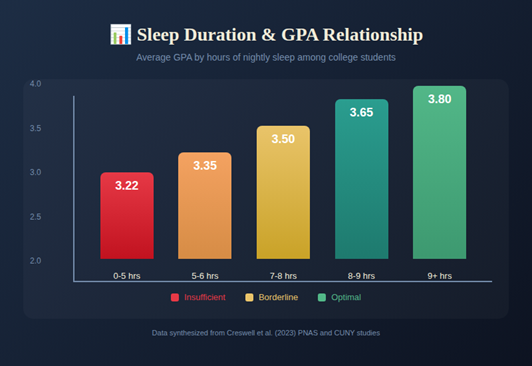
The study also identified a critical range: students sleeping fewer than 6 hours per night experienced a pronounced decline in academic performance. Lead researcher David Creswell noted that “once you start dipping below six hours, you are starting to accumulate massive sleep debt that can impair a student’s health and study habits” (Carnegie Mellon University, 2023). This finding suggests that sleeping less than 6 hours represents a range particularly associated with poor academic outcomes.
These findings align with earlier research showing robust correlations between sleep and academic performance. A study by Lowry et al. (2010) found that GPA decreases as the average number of days per week that a student sleeps fewer than five hours increases. Notably, predictive relationships with GPA were specific to total nightly sleep duration, not other markers of sleep such as bedtime timing variability.
The All-Nighter Myth: Why Cramming Fails
Sleep restriction studies in adults show significant cognitive and performance decrements. A popularization of research in this area suggests that after two weeks of sleeping six hours or less per night, performance deficits on certain vigilance tasks approximate those observed after 48 hours of continuous wakefulness (Epstein, 2007, summarizing findings from the American Academy of Sleep Medicine). It is important to note that these results come from controlled adult studies and may not directly apply to college populations.
After 17 hours without sleep, cognitive and motor impairments on certain tasks reach levels comparable to a blood alcohol concentration of 0.05% on some measures; legal limits for driving vary (typically 0.08% in much of the U.S.) (Williamson & Feyer, 2000).
A UCLA study (Gillen-O’Neel et al., 2013) found that when students sacrificed sleep to study more, they experienced more academic problems the following day. The explanation is mechanistic: cramming relies on short-term memory, which fades quickly, whereas sleep-dependent consolidation is required for long-term retention.
Why Sleep “Washes” the Brain: The Glymphatic System
The term “brain fog” may be more literal than metaphorical. In 2012–2013, Dr. Maiken Nedergaard and colleagues at the University of Rochester discovered the glymphatic system – a network of channels that clears metabolic waste from the brain during sleep. Using in vivo two-photon imaging in mice, they found that the interstitial space volume increases by roughly 60% during sleep, which functionally allows cerebrospinal fluid to flow more freely and remove beta-amyloid proteins and other toxic metabolites linked to Alzheimer’s disease (Xie et al., 2013).
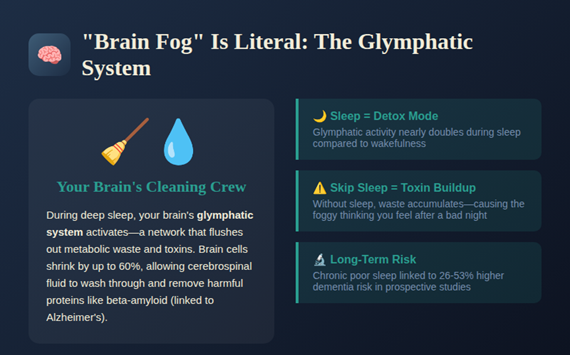
Critically, this clearance activity is sharply suppressed during wakefulness. Glymphatic transport is controlled by the brain’s arousal level – when we’re awake, cerebrospinal fluid influx into the brain is minimal, but almost immediately after sleep onset or anesthesia induction, significant tracer influx occurs (Xie et al., 2013). A 2024 study using contrast-enhanced MRI provided in vivo human evidence consistent with glymphatic-type cerebrospinal fluid flow, suggesting that sleep-related brain cleaning may occur in living humans as well as animal models (Yamamoto et al., 2024).
When students skimp on sleep, metabolic waste may accumulate, contributing to cognitive sluggishness. A systematic review on sleep regularity and cognitive aging (Kalkanis et al., 2025) found that irregular sleep schedules were associated with higher dementia risk and smaller hippocampal volume in some observational studies – the brain region critical for learning and memory formation. These are observational associations, and the mechanisms linking chronic sleep deprivation to structural brain changes remain an active area of research.
Why Consistent Sleep Matters More Than You Think
A large prospective cohort study published in SLEEP analyzed over 10 million hours of accelerometer data from 60,977 UK Biobank participants. The findings were notable: in adjusted models, indices of sleep regularity showed stronger associations with mortality risk than sleep duration alone. Participants with the most stable interdaily sleep–wake patterns had lower risk of mortality from all causes and cardiometabolic causes compared to those with the least regular schedules (Windred et al., 2024).
The National Sleep Foundation released a consensus statement in 2023 that, based on existing evidence, emphasizes that consistency in sleep timing is important for health, safety, and performance (Sletten et al., 2023). A systematic review (Kalkanis et al., 2025) found evidence linking sleep-timing irregularity to higher rates of depression, anxiety, obesity, insulin resistance, hypertension, and cardiovascular events.
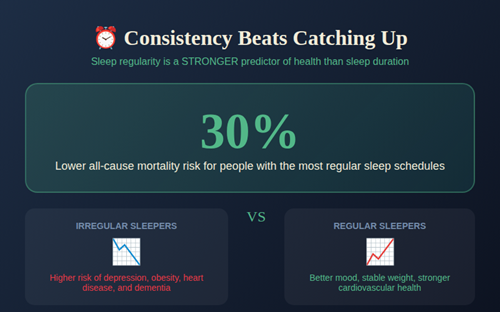
For students, this means that maintaining a regular sleep schedule – even if total sleep time is slightly suboptimal – may be more protective than erratic patterns of sleep debt followed by “catch-up” sleep. The practice of staying up late on weekends and sleeping in creates what researchers call “social jet lag,” which has been associated with health risks similar to those linked to chronic sleep deprivation in observational studies.
Social Jet Lag: The Weekend Sleep Trap
Social jet lag describes the chronic mismatch between biological and social time – typically manifesting as later bedtimes and wake times on weekends compared to weekdays (Wittmann et al., 2006). Studies estimate that 80% of the population experiences some degree of social jet lag, with over 70% shifting their sleep schedule by at least one hour on weekends (Roenneberg et al., 2012).
The UC Berkeley study analyzing 3.4 million learning management system logins found that students with greater misalignment between their biological rhythms and class schedules had significantly lower GPAs (Smarr & Schirmer, 2018). Social jet lag has been linked to increased risk of depression, obesity, cardiovascular problems, and metabolic dysfunction in observational studies (Roenneberg et al., 2012).
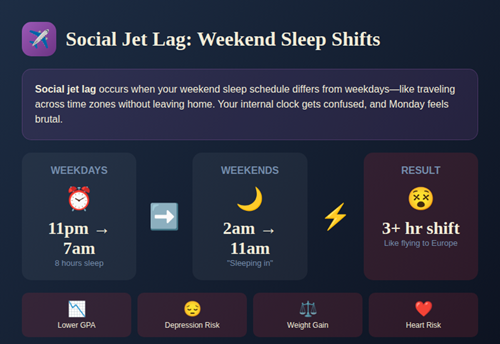
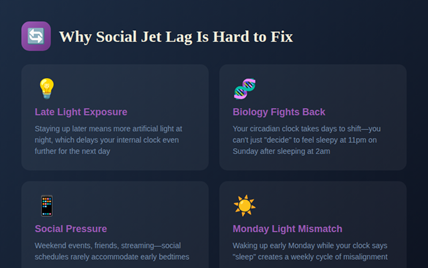
Why is social jet lag so difficult to overcome? Several biological mechanisms work against students:
- Later weekend bedtimes mean more artificial light exposure at night, which delays the circadian clock further by suppressing melatonin release;
- The circadian system typically adjusts by only 30–60 minutes per day, far slower than the two-day weekend allows;
- Monday morning’s alarm forces early awakening while the internal clock still signals “sleep”; and
- Academic and social pressure makes weeknight sleep extension feel impossible. This creates a vicious cycle where each weekend resets students’ progress toward alignment.
Sleep and Mental Health: A Bidirectional Relationship
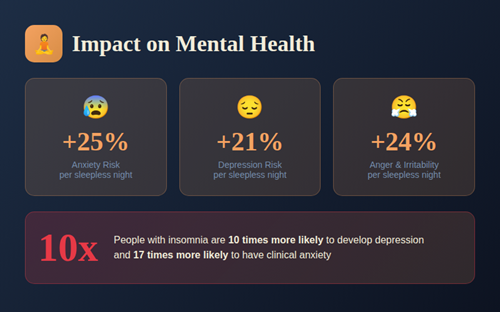
Poor sleep and mental health exist in a bidirectional relationship: insufficient sleep is associated with increased mental health risk, while mental health conditions disrupt sleep. Research indicates that people with insomnia show substantially higher prevalence of depression and anxiety disorders in observational studies; Stanford Medicine (2025) describes that individuals with insomnia are up to ~10 times more likely to have depression and up to ~17 times more likely to have anxiety than the general population in certain epidemiologic comparisons, though such relative likelihoods vary across populations and study designs.
Cross-sectional and longitudinal research by Ramsey and Grandner (2019) on nightly sleep insufficiency in college students found associations with increased odds of experiencing depressive and anxiety symptoms the following day, with estimated odds ratios suggesting increases of roughly 21% for depression-related symptoms, 25% for anxiety-related symptoms, 24% for anger, and 28% for suicidal ideation per sleepless night. These figures refer to same-day or next-day symptom outcomes in a specific college cohort and should not be generalized as universal lifetime risk multipliers.
Evening chronotype has been linked to increased risk for depression, anxiety, and substance abuse among young adults (Li et al., 2020). With 14.8% of college students already diagnosed with depression, the stakes of addressing sleep are particularly high for this population.
Sleep and Physical Health: The Immune System Connection
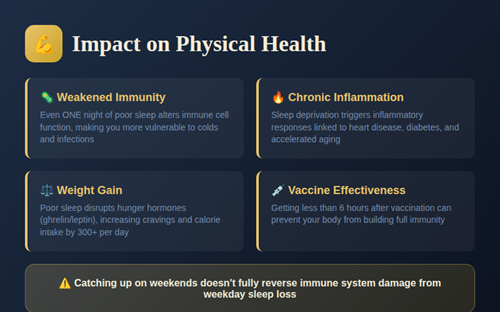
A comprehensive review by Besedovsky et al. (2021) found that sleep deprivation alters immune parameters, creating chronic low-grade inflammation linked to cardiovascular disease and diabetes. Research in the Journal of Immunology (Al-Rashed et al., 2025) demonstrated that acute sleep deprivation in controlled laboratory settings alters immune cell profiles; these shifts show some similarities to pro-inflammatory patterns observed in metabolic dysfunction, though the biological significance and long-term clinical implications remain under investigation.
A Mount Sinai study (2022) found that sleep loss in animal models changes gene expression patterns in immune stem cells – effects that persisted even after recovery sleep. This represents animal research with uncertain implications for healthy young adults. Whether such findings translate to lasting immune function changes in humans during college years requires further investigation.
Impact on Future Career Success
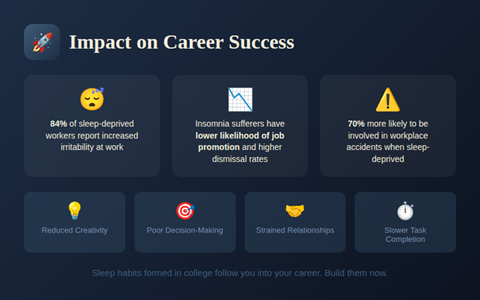
Sleep habits established during college often persist into careers. Research and reviews examining occupational sleep deprivation, including work by Pilcher et al. (2020), found that sleep loss has been associated with decreased job performance, lower productivity, and increased accidents and absenteeism in occupational cohorts. A Hult Business School survey found that 84% of self-reported sleep-deprived workers report increased irritability, affecting workplace relationships and collaboration.
Kucharczyk et al. (2012) found that individuals with chronic insomnia have lower promotion likelihood and higher dismissal rates. Occupational safety literature reports that fatigue and shift work contribute to workplace accidents. The human cost of sleep deprivation extends beyond individual performance: accident investigation reports and safety literature often cite operator fatigue and demanding schedules as contributing factors to major incidents such as the Three Mile Island nuclear incident, Chernobyl disaster, Exxon Valdez oil spill, and Space Shuttle Challenger explosion, though the degree to which sleep deprivation specifically “caused” these events remains interpretive and contested.
What Faculty Can Do: Teaching Students About Sleep
Share the Science
Students often make rational decisions based on incomplete information. Sharing research findings – like Okano et al.’s finding that sleep the week before exams matters more than cramming the night before, or Creswell et al.’s finding that each additional hour of sleep is associated with a 0.07 GPA increase – can reshape their study strategies.
Challenge the All-Nighter Culture
When professors praise students who sacrifice sleep or share stories of their own academic all-nighters, they reinforce harmful norms. Explicitly discourage all-nighters and celebrate balanced approaches to academic success.
Recommend Effective Study Strategies
Guide students toward spaced practice: 20–30 minute study sessions repeated over 3–4 days before exams, rather than marathon cramming sessions. Recommend reviewing material in the evening, then sleeping to allow memory consolidation.
Designing Sleep-Friendly Courses
Rethink Assignment Deadlines
Institutional teaching research from UNC (Aldrich, 2023) found that when assignment deadlines were set at 11:59 PM, 71% of submissions occurred after midnight. When the “due” time was shifted to 9:00 PM (with acceptance until 9:00 AM the following day), most submissions moved to before midnight. Consider setting evening deadlines to discourage late-night work.
Distribute Workload Evenly
Avoid clustering major deadlines around midterms and finals. Use frequent low-stakes assessments that encourage regular engagement rather than cramming.
Structure Exams to Reward Consistent Learning
Design assessments that test deep understanding rather than rote memorization, making cramming less effective. Include cumulative elements that reward sustained engagement throughout the semester.
Consider Class Scheduling
When possible, advocate for class schedules that account for students’ circadian biology. Early morning classes (before 8:00 AM) may be particularly challenging for students with evening chronotypes, who represent a significant portion of the college population.
Institutional Recommendations
Beyond individual faculty efforts, institutions can support student sleep health by:
- Minimizing 8:00 AM course offerings (or considering alternative start times);
- Establishing policies discouraging midnight assignment deadlines;
- Developing campus nap spaces;
- Enforcing residence hall quiet hours;
- Ensuring services that produce loud sounds (g., garbage collection, lawn maintenance) do not occur near residence halls until after 9:00 AM;
- Creating a campus culture that values wellness;
- Offering sleep education through health services and orientation programs; and
- Training academic advisors to discuss sleep as part of student success planning.
Conclusion
The research strongly supports the conclusion that sleep is not a luxury that interferes with achievement – it is a biological necessity that enables it. When students sleep well and consistently, they learn better, remember more, think more clearly, regulate emotions more effectively, and position themselves for long-term success in their careers and lives.
As faculty, we can become advocates for student sleep. By sharing research, adjusting course designs, challenging cultural norms that glorify sleep deprivation, and acknowledging the biological realities of young adult circadian rhythms, we help students develop habits that will serve them throughout their careers and lives. The investment is minimal; the returns – in learning, health, and human flourishing – are profound.
Enjoyed this article?
We write about these topics because we believe informed people make better financial decisions. If that resonates, we’d love to stay in touch.
Sign up for our e-newsletter and receive “Ten Tough Questions You Should Ask Any Financial Advisor” — a free PDF guide to help you find a fiduciary, fee-only advisor you can truly trust.
About the Author
Dr. Ron A. Rhoades is an Associate Professor of Finance and Co-Director of the Cerity Partners Financial Planning Program at Western Kentucky University’s Gordon Ford College of Business. He has and continues to develop his own textbooks that integrate evidence-based learning science with practical skill development.
References
[1] Al-Rashed, F., et al. (2025). Single 24-hour sleep deprivation alters immune cell profile. Journal of Immunology.
[2] Aldrich, A. (2023). Assignment deadline timing and student submission patterns. UNC Teaching Research.
[3] Besedovsky, L., et al. (2021). The sleep–immune crosstalk. Nature and Science of Sleep, 13, 799–815.
[4] Carnegie Mellon University. (2023, February 13). Nightly sleep is key to student success. https://www.cmu.edu/dietrich/news/news-stories/2023/february/creswell-sleep.html
[5] Centers for Disease Control and Prevention. (2016). Prevalence of healthy sleep duration among adults – United States, 2014. MMWR, 65(6), 137–141. https://www.cdc.gov/mmwr/volumes/65/wr/mm6506a1.htm
[6] Creswell, J. D., et al. (2023). Nightly sleep duration predicts grade point average in the first year of college. Proceedings of the National Academy of Sciences, 120(8), e2209123120. https://www.pnas.org/doi/10.1073/pnas.2209123120
[7] Crowley, S. J., Acebo, C., & Carskadon, M. A. (2007). Sleep, circadian rhythms, and delayed phase in adolescence. Sleep Medicine, 8(6), 602–612. https://pubmed.ncbi.nlm.nih.gov/17383934/
[8] Epstein, L. (2007). College students: Sleep vital to success. American Academy of Sleep Medicine.
[9] Gillen-O’Neel, C., Huynh, V. W., & Fuligni, A. J. (2013). To study or to sleep? The academic costs of extra studying at the expense of sleep. Child Development, 84(1), 133–142.
[10] Hagenauer, M. H., Perryman, J. I., Lee, T. M., & Carskadon, M. A. (2009). Adolescent changes in the homeostatic and circadian regulation of sleep. Developmental Neuroscience, 31(4), 276–284. https://pmc.ncbi.nlm.nih.gov/articles/PMC2820578/
[11] Hershner, S. D., & Chervin, R. D. (2014). Causes and consequences of sleepiness among college students. Nature and Science of Sleep, 6, 73–84. https://pmc.ncbi.nlm.nih.gov/articles/PMC4075951/
[12] Hirshkowitz, M., et al. (2015). National Sleep Foundation’s sleep time duration recommendations: Methodology and results summary. Sleep Health, 1(1), 40–43.
[13] Kalkanis, A., et al. (2025). Sleep regularity: A systematic review. Sleep Medicine Reviews.
[14] Kucharczyk, E. R., Morgan, K., & Hall, A. P. (2012). The occupational impact of sleep quality and insomnia symptoms. Sleep Medicine Reviews, 16(6), 547–559.
[15] Li, T., Xie, Y., Tao, S., et al. (2020). Chronotype, sleep, and depressive symptoms among Chinese college students: A cross-sectional study. Frontiers in Neurology, 11, 592825. https://www.frontiersin.org/journals/neurology/articles/10.3389/fneur.2020.592825/full
[16] Lowry, M., Dean, K., & Manders, K. (2010). The link between sleep quantity and academic performance for the college student. Sentience, 3, 16–19.
[17] Okano, K., Kaczmarzyk, J. R., Dave, N., Gabrieli, J. D. E., & Grossman, J. C. (2019). Sleep quality, duration, and consistency are associated with better academic performance in college students. npj Science of Learning, 4, 16. https://www.nature.com/articles/s41539-019-0055-z
[18] Pilcher, J. J., Morris, D. M., Donnelly, J., & Feigl, H. B. (2020). Interactions between sleep habits and self-control. Frontiers in Psychology, 11, 45.
[19] Ramsey, T., & Grandner, M. A. (2019). Sleep and mental health in the transition to college. Sleep, 42(Suppl_1), A234.
[20] Roenneberg, T., Allebrandt, K. V., Merrow, M., & Vetter, C. (2012). Social jetlag and obesity. Current Biology, 22(10), 939–943.
[21] Roenneberg, T., Kuehnle, T., Pramstaller, P. P., et al. (2004). A marker for the end of adolescence. Current Biology, 14(24), R1038–R1039.
[22] Sletten, T. L., Weaver, M. D., Foster, R. G., et al. (2023). The importance of sleep regularity: A consensus statement of the National Sleep Foundation sleep timing and variability panel. Sleep Health, 9(6), 801–820.
[23] Smarr, B. L., & Schirmer, A. E. (2018). 3.4 million real-world learning management system logins reveal the majority of students experience social jet lag correlated with decreased performance. Scientific Reports, 8, 4793. https://www.nature.com/articles/s41598-018-23044-8
[24] Walker, M. (2017). Why we sleep: Unlocking the power of sleep and dreams. Scribner.
[25] Watson, N. F., et al. (2015). Recommended amount of sleep for a healthy adult: A joint consensus statement of the American Academy of Sleep Medicine and Sleep Research Society. Sleep, 38(6), 843–844. https://pmc.ncbi.nlm.nih.gov/articles/PMC4434546/
[26] Williamson, A. M., & Feyer, A. M. (2000). Moderate sleep deprivation produces impairments in cognitive and motor performance equivalent to legally prescribed levels of alcohol intoxication. Occupational and Environmental Medicine, 57(10), 649–655.
[27] Windred, D. P., Burns, A. C., Lane, J. M., et al. (2024). Sleep regularity is a stronger predictor of mortality risk than sleep duration: A prospective cohort study. Sleep, 47(1), zsad253. https://academic.oup.com/sleep/article/47/1/zsad253/7280269
[28] Wittmann, M., Dinich, J., Merrow, M., & Roenneberg, T. (2006). Social jetlag: Misalignment of biological and social time. Chronobiology International, 23(1–2), 497–509.
[29] Wolgast, B. (2024, March). Sweet dreams: 6 questions about sleep for college students. University of Delaware. https://www.udel.edu/students/news/2024/march/sweet-dreams-6-questions-about-sleep-for-college-students/
[30] Xie, L., et al. (2013). Sleep drives metabolite clearance from the adult brain. Science, 342(6156), 373–377. https://www.science.org/doi/10.1126/science.1241224
[31] Yamamoto, E. A., et al. (2024). The perivascular space is a conduit for cerebrospinal fluid flow in humans. Proceedings of the National Academy of Sciences, 121(42), e2407246121.
[32] Zuraikat, F. M., Aggarwal, B., Jelic, S., & St-Onge, M. P. (2024). Consistency is key: Sleep regularity predicts all-cause mortality. Sleep, 47(1), zsad285. https://academic.oup.com/sleep/article/47/1/zsad285/7344663
This article is for educational purposes only. The characters depicted are fictional and any relation to real persons is solely incidental. Scenarios and references to real people or experiences are used solely to illustrate educational concepts. These examples may not apply to your individual circumstances. It should not be construed as financial, legal, tax, or investment advice, nor as a recommendation to implement any specific strategy, product, or investment.
Advisory services are offered through XYPN Sapphire and its various IAR brands under which it operates. XYPN Sapphire is an SEC registered investment adviser. For additional disclosure and privacy information, please visit XYPNSapphire.com/disclosures.


