
“Smile, Greet, Engage” – Addressing The Quiet Crisis Walking Past You Every Day
A Call to Transform Higher Education Through Human Connection
by Ron A. Rhoades, JD, CFP®
Pedagogical Associate Professor of Finance and Co-Director, Cerity Partners Financial Planning Program, Department of Finance, Gordon Ford College of Business, Western Kentucky University; Email: ron.rhoades@wku.edu
Maria Santos sat on the cold stone bench outside Morrison Library, her backpack at her feet, her phone dark in her hands. She had been there for 47 minutes. In that time, she had counted 127 people walk past her. Faculty hurrying to meetings. Students scrolling through phones. Staff pushing carts of supplies. Not one had looked at her. Not one had nodded. Not one had acknowledged that she existed at all.
Maria was deciding something in that moment. She didn’t know it consciously, but her mind was calculating: Do I belong here? Does anyone see me? Would anyone notice if I left?
Three buildings away, Professor Bear was preparing for his most important lecture of the semester. Not about investments or estate planning – his usual subjects – but about something he had come to believe was the most critical skill any professional could develop.
He called it, “Smile, Greet, Engage.”
And in about twenty minutes, Maria Santos would wander into the classroom and begin a transformation that would reshape not just her college experience, but her entire life.
This is that story. And it might just be your story too.
Part One: The Invisible Campus
What if the biggest threat to student success isn’t academic rigor, financial burden, or career uncertainty – but simple invisibility?
Walk across any college campus at midday. What do you see? Hundreds of people moving in parallel isolation. Earbuds in. Eyes down. Faces illuminated by screens. Bodies present, spirits elsewhere.
The Loneliness Epidemic
We are facing a loneliness crisis of unprecedented proportions on our college campuses. According to a 2024 national survey of nearly 1,100 college students conducted by Active Minds and TimelyCare, nearly two-thirds (64.7%) of college students report feeling lonely, with 28% feeling isolated from others, 23% feeling left out, and 21% lacking companionship.[1] Perhaps most alarming: students who report feeling lonely are more than four times more likely to experience severe psychological distress.
U.S. Surgeon General Vivek Murthy has declared loneliness a public health “epidemic,” noting that lacking social connection carries health risks comparable to smoking.[2] Yet on our campuses – places ostensibly designed to bring people together for learning and growth – students walk past each other by the thousands each day without a single moment of human acknowledgment. The infrastructure for connection surrounds them; the connection itself remains painfully absent.
This is not a problem that counseling centers alone can solve. This is a cultural crisis that demands a cultural response – from every faculty member, every staff member, every administrator, and every student who has ever felt invisible and wished someone would simply say hello.
We have built institutions of higher learning that are extraordinarily efficient at processing people – enrolling them, scheduling them, grading them, graduating them – while simultaneously failing at the most fundamental human task: seeing them.
Maria had transferred to the university six weeks earlier. She had attended every class, visited the library daily, eaten in the dining hall three times a day. She had interacted with exactly four people beyond the transactional minimum: her assigned roommate, a professor who called on her in class, a cashier who said “have a nice day,” and a wrong number who texted asking for someone named Derek.
Six weeks. Four human connections. And she was drowning.
This is not Maria’s failure. This is ours.
The Mission We’ve Forgotten
Every university has a mission statement about transformation and community. Many are not living it.
Somewhere along the way, higher education became transactional. Students became enrollment numbers. Faculty became publication metrics. Staff became budget lines. Administrators became meeting attendees. We created strategic plans with soaring language about belonging and community, then put in our earbuds and walked past each other without a glance.
The mission statements hanging in our lobbies speak of transformation, growth, and preparing students for meaningful lives. But transformation doesn’t happen in isolation. Growth doesn’t occur in silence. And meaningful lives are built on meaningful connections.
It’s time to return to our mission – not the one on the wall, but the one that called us to this work in the first place.
Part Two: Professor Bear’s Unexpected Lesson
The most important career skill isn’t on any syllabus. But one professor decided to teach it anyway.
Professor Bear had taught Investments for 15 years. He had published papers, served on committees, mentored countless students through internships and job searches. In his third year of teaching, he had come to a realization.
“I started tracking my students after graduation,” he would later explain. “Not just their job placements – everyone does that. I tracked who thrived and who struggled. Who got promoted and who got stuck. Who reported being happy and who reported feeling lost.”
The pattern surprised him. The students who flourished were not necessarily the ones with the highest GPAs or the most prestigious internships. They were the ones who could walk into any room and connect. Who remembered names. Who asked questions and actually listened to answers. Who made others feel seen.
“The skill that mattered most,” Professor Bear realized, “was the one I’d never explicitly taught.”
So, he started teaching it.
The Three Words That Change Everything
Maria slipped into the back of Professor Bear’s classroom that Thursday.
Professor Bear stood at the front of the room – without slides, without notes. “I’m going to teach you the most valuable professional skill you’ll learn in college,” he began. “It’s not in your textbook. It won’t be on any exam. And most of you have never been explicitly taught how to do it.”
He wrote three words on the board:
SMILE. GREET. ENGAGE.
“This isn’t soft. This isn’t trivial. This is the foundation of every successful career, every meaningful relationship, and every community worth belonging to.”
A student in the front row raised his hand. “Professor, isn’t this just… being nice? Don’t we already know how to do this?”
“Let me ask you something,” Professor Bear replied. “How many people did you acknowledge on your way to this classroom today? Not interact with – just acknowledge. A nod. A smile. Eye contact.”
One student answered: “Maybe… one? Two?”
“And how many people did you pass?”
Another student replied: “Probably fifty.”
“So, you ignored 96% of the human beings you encountered. And you think you already know how to connect?”
The room fell silent. In the back row, Maria felt something shift.
Professor Bear’s Framework
Three simple actions. Infinite compound returns.
“Let me break this down,” Professor Bear continued.
SMILE. Before you even know if someone will smile back. Offer warmth without conditions. It costs nothing and changes everything. Research shows that a genuine smile activates mirror neurons in others, literally making them feel what you are projecting. You’re not just being pleasant – you are creating neurological change in every person you encounter. You bring benefits to others.
GREET. A simple “hello,” “good morning,” or a nod of recognition. Acknowledge presence. Break the bubble of isolation. This seems small, but consider: how many people feel invisible on any given day? Your greeting might be the only acknowledgment someone receives. You’re not just saying hello – you’re saying “I see you. You exist. You matter.”
ENGAGE. When time and context allow, go deeper. Ask a question. Show genuine interest. Connect. This is where relationships begin, where opportunities emerge, where community forms. This is the skill that will define your career and your life.
Another student spoke up: “But how do we actually do the ‘engage’ part? What do we even say?”
“Excellent question,” Professor Bear said. “And that’s exactly what we’re going to practice.”
[Are students really impacted by such instruction? … From a student’s recent evaluations: “Having changed majors, I felt like I restarted college the way I started initially, but Dr. Bear’s lessons about life and what truly matters helped push me to reconnect with old friends, make new friends, introduce those friends to grow new connections, and step out of my comfort zone whenever possible. The growth I experienced this semester has changed not just my college experience, but my life. Whether it was developing new ways to study or expanding my comfort zone, I have seen myself grow and move closer to the person I want to be. Words cannot convey how great of an impact Dr. Bear has had on me, but I hope that the lasting relationships I can make throughout my life can at least share the valuable lessons I have learned with others.”]
Part Three: Mastering the Art of Engagement
The difference between awkward and authentic is practice. Here’s how to get it.
Professor Bear continued. “Engagement isn’t mysterious. It’s a skill. And like any skill, it can be learned, practiced, and mastered. Let me give you the tools.”
Conversation Starters That Actually Work
The magic isn’t in the perfect question. It’s in the genuine curiosity behind it.
For Fellow Students:
- “I’m [name] – I don’t think we’ve met. What’s your major?”
- “That’s a great [laptop sticker/shirt/bag] – what’s the story behind it?”
- “How’s your semester going so far?”
- “What’s keeping you busy these days?”
- “Have you found any good spots on campus to study?”
- “What are you most looking forward to this week?”
- “What brought you to this university?”
For Professors and Faculty:
- “What drew you to this field originally?”
- “What advice would you give someone considering this career path?”
- “What’s the most interesting development in your field right now?”
- “Is there anything you wish you’d known when you were starting out?”
- “What skills do you think are most important for success in this profession / industry?”
For Staff and Colleagues:
- “I see you around a lot – what department are you with?”
- “What are some of the things that you do?”
- “Is there anything I can help you with today?”
- “What do you enjoy most about your role?”
- “How long have you been working here? What keeps you?”
- “What’s been a bright spot in your week?”
For Anyone, Anywhere:
- “I don’t think we’ve met – I’m [name].”
- “That looks interesting – what are you working on?”
- “Any fun plans for the weekend?”
The Secret Ingredient: Active Listening
Starting a conversation is easy. What separates masters from amateurs is what happens next.
“Here’s where most people fail,” Professor Bear told the class. “They ask a question, then spend the entire time the other person is talking thinking about what they’ll say next. That’s not engagement. That’s waiting for your turn to talk.”
Professor Bear outlined the principles of active listening:
(1) Be fully present. Put away your phone. Stop scanning the room. Give the person in front of you your complete attention.
(2) Listen to understand, not to respond. Your job isn’t to formulate your next brilliant comment. It’s to genuinely comprehend what the other person is sharing.
(3) Ask follow-up questions. When someone tells you something, dig deeper. “Tell me more about that.” “What was that like?” “How did that make you feel?”
(4) Reflect back what you hear. “It sounds like you’re saying…” “So what I’m hearing is…” This shows you’re paying attention and gives them a chance to clarify.
(5) Remember details. When you see them again, reference something from your previous conversation. Nothing makes someone feel more valued than being remembered.
Building Your Skills: Resources and Practice
You don’t have to figure this out alone. The best communicators are always learning.
“I want you to study connection the way you’d study any subject,” Professor Bear said. “Watch YouTube videos on small talk, big talk, active listening, and how to initiate and sustain relationships. Read books about emotional intelligence. Observe people who do this well. Analyze what makes them effective.”
Recommended Self-Study Topics:
- Small talk mastery: How to move beyond weather and surface topics.
- Big talk techniques: Asking meaningful questions that create genuine connection.
- Active listening exercises: Practice drills to improve focus and retention.
- Body language fundamentals: What your posture and expressions communicate.
- Relationship initiation: Moving from stranger to acquaintance to connection.
- Networking authentically: Building professional relationships without feeling transactional.
Part Four: Your Comfort Zone Expansion Plan
Growth doesn’t happen in comfort. But discomfort doesn’t have to mean panic. Here’s your graduated practice plan.
“I’m giving you homework,” Professor Bear announced. “But not the kind you’re used to. This is Expand Your Comfort Zone homework. Start small. Build gradually. Master each level before moving to the next.”
Level 1: The Foundation (Week 1-2)
Before you can run, you must walk. Before you can connect, you must acknowledge.
“Smile When Entering Any Room.” Before you walk through any doorway – classroom, dining hall, library, office – pause for one second and consciously put a pleasant expression on your face. Enter as if you’re genuinely happy to be there.
“Greet Others in Hallways.” Make eye contact with at least five people per day and give a simple nod or “hey.” Keep track. It’s harder than you think.
“The First Fifteen Challenge.” For the first fifteen minutes you’re on campus each day, commit to greeting every single person you pass. No exceptions. No averting your eyes.
At the end of each day, handwrite on a piece of paper one paragraph about how your day – and interactions with others – went. Reflect on what you might do to improve.
Level 2: First Conversations (Week 3-4)
The person sitting next to you could become a lifelong friend. But only if you say hello.
“Start a Conversation in Class.” Before class begins, turn to someone sitting near you and ask one question: “Have you taken a class with this professor before?” or “What made you choose this course?” Just one exchange. That’s it.
“The Name Challenge.” Learn and use one new person’s name every single day. When you learn their name, use it in conversation: “Nice to meet you, Marcus.” The next time you see them: “Hey Marcus, how’s it going?”
“The Study Spot Conversation.” In the library or a coffee shop, ask someone nearby a simple question: “Is this seat taken?” followed by “What are you working on?” Don’t force an extended conversation – just plant a seed.
Again, write a brief entry in a journal at the end of each day, reflecting on how you might improve during the next day’s interactions.
Level 3: Building Relationships (Week 5-8)
Acquaintances become connections when someone makes the first intentional move. Why not you?
“Visit a Professor’s Office Hours.” Go with five questions prepared – not about assignments, but about their career and field: What drew you to this work? What do you wish you’d known starting out? What skills matter most? What’s the most interesting development in your field right now? What advice would you give someone considering this path?
“Reach Out to Alumni on LinkedIn.” Find three alumni who work in fields that interest you. Send a thoughtful connection request and ask for a 15-minute informational interview, either in-person or via Zoom. Prepare a list of just 8 questions to learn about the person and their career. Listen actively. Follow up with a handwritten thank you note, in which you enclose your student business card.
“The Follow-Up.” When you see someone you have talked to before, reference your previous conversation: “Hey, how did that project turn out?” or “Did you end up trying that restaurant you mentioned?” This signals that you were genuinely listening and that they matter to you.
Level 4: Community Building (Ongoing)
The ultimate level isn’t about receiving connection – it is all about creating it for others.
“No One Eats Alone.” Designate one day a month where you commit to sitting with someone who is eating alone. Simply ask: “Mind if I join you?” You might be the only person who’s acknowledged them all day.
“Establish a Community Table.” Work with dining services to create a designated table where anyone can sit if they want conversation. Promote it. Volunteer to sit there yourself during busy times to welcome newcomers.
“Become a Connection Ambassador.” Train yourself to spot people who look lost, lonely, or uncertain. Approach them proactively. “Hey, you look like you might be looking for something – can I help?” or “I haven’t seen you around before – are you new here?”
“Adopt-a-Spot.” Choose a location on campus – a bench, a lounge, a corner of the library – and commit to being a welcoming presence there. Strike up conversations with anyone who seems like they could use a friendly face.
Part Five: Scaling Connection Through Student Organizations
What if every Greek organization, every club, every team adopted “Smile, Greet, Engage” as a core value? What if connection became contagious?
“Individual practice is powerful,” Professor Bear said, leaning forward. “But collective practice transforms culture. I want you to take this back to your organizations.”
A Challenge to Every Student Organization
Whether you’re part of a fraternity or sorority, an academic club, an athletic team, a residence hall council, or any student group – you have the power to shift campus culture.
Frame It This Way to Your Members: “The skills that will make you successful in your career and life are not just learned in classrooms. They are practiced in hallways, dining halls, and chance encounters. Every time you smile at someone who looks lonely, greet someone you don’t know, or engage someone in brief conversation, you’re not just helping them – you are training yourself for the interviews, the client meetings, the team dynamics, and the relationships that will define your future.”
Implementation Ideas for Organizations
“Smile, Greet, Engage” Week: Challenge all members to track their daily acknowledgments. Share stories at meetings about connections made.
New Member Orientation: Make “Smile, Greet, Engage” an explicit value taught to every person who joins. This is who we are.
Adopt-a-Spot Program: Each organization “adopts” a campus location and commits to being welcoming hosts there.
Connection Ambassadors: Train members to be intentionally present in dining halls, libraries, and common spaces, watching for isolated individuals.
Cross-Org Challenges: Partner with other organizations for friendly competitions – who can make the most genuine connections in a week?
Reflection Sessions: At each meeting, have members share one meaningful connection they made since the last gathering.
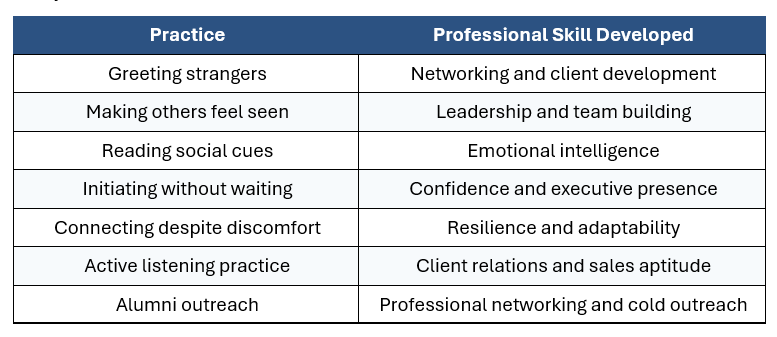
The Professional Skills You’re Actually Building
Think this is just about being nice? Think again. You’re building career capital with every interaction.
“Let me be very clear about what you’re developing,” Professor Bear told the class. “These aren’t soft skills. They’re essential skills that employers desperately want and rarely find.”
Part Six: A Call to Faculty, Staff, and Administrators
Students learn more from what we model than from what we teach. What are we teaching them by walking past each other in silence?
After class, Professor Bear gathered several colleagues who had been invited to observe his unconventional lesson.
“This can’t just be a student initiative,” he said. “If we want a connected campus, we – faculty, staff, administrators – have to model it. Every day. Without exception.”
What Every Faculty Member Can Do
Arrive early to class and talk with students. Not about coursework, but about them. How’s the semester? What else are you involved in? What are their plans for the upcoming break? Have they considered doing reverse (informational) interviews themselves? Have they explored externships and internships, or study abroad?
Learn names quickly and use them. Nothing signals care like remembering who someone is. In large classes consider a seating chart, so you can call out names when calling upon a student who is answering a question, or when calling a group to the front of the classroom.
Greet students you recognize across campus. Don’t pretend you don’t see them. A simple “Hi Sarah, how did that exam go?” or “How ‘ya doing” takes three seconds and makes a lasting impression.
Make office hours about connection. Not just about answering questions. Ask students about their goals, their challenges, their lives. Consider requiring every student to have a 15-minute conversation with you. Or, in a career development or other suitable class, assigning every student to interview two faculty members in their major(s) or minor(s) or certificate program.
Smile when you enter any room. Students are watching. If you look miserable, they’ll assume this work is miserable.
What Every Staff Member Can Do
See students as people, not transactions. The student across from your desk isn’t an interruption. They are the reason you’re here.
Learn the regulars. The student who studies in “your” building every night. The one who always gets coffee at 8 AM. Acknowledge them by name.
Be the friendly face. For many students, you may be the only adult they interact with outside of class. Make it count.
Greet colleagues too. Staff can feel just as invisible as students. A culture of connection starts with us.
What Every Administrator Can Do
Walk your campus regularly – not in a rush between meetings. Walk slowly. Make eye contact. Stop and talk.
Model the behavior you want to see – if you want a connected campus, be connected. Greet the facilities worker. Chat with the student waiting for the elevator.
Champion this initiative – make “Smile, Greet, Engage” part of new employee orientation. Recognize those who exemplify it. Talk about it in speeches and communications.
Create infrastructure for connection – community tables in dining halls, welcoming spaces in buildings, programs that bring people together across roles and departments.
Part Seven: The Ripple Effect
One smile creates another. One greeting multiplies. One genuine connection can change a life. And the life it changes might be your own.
Maria Santos walked out of Professor Bear’s classroom different than she had walked in. She didn’t have all the answers. She still felt uncertain and a little lost. But something had shifted.
On her way to the dining hall, she nervously made eye contact with a student walking the opposite direction. Instead of looking away, she smiled. The student smiled back.
In the dining hall, she noticed a young man sitting alone, looking at his phone with the kind of intensity that suggested he was avoiding eye contact with the room. She thought about walking past. Instead, she walked over.
“Mind if I join you? I’m Maria.”
He looked up, surprised. “Uh, sure. I’m James.”
“How’s your semester going, James?”
It was a small thing. A tiny thing. But James had been sitting alone in that dining hall for three weeks, wondering if anyone would ever talk to him. He had been starting to think about leaving. He had been starting to feel invisible.
Not anymore.
The Compound Returns of Human Connection
When you smile at someone, they’re statistically more likely to smile at the next person they see. Warmth spreads. Connection multiplies. Research consistently shows:
(1) Students who feel connected to their campus community are significantly more likely to persist through challenges and graduate.
(2) Faculty and staff who experience collegial warmth report higher job satisfaction and lower burnout.
(3) A single moment of genuine acknowledgment can shift someone’s entire day – and sometimes their trajectory.
(4) Brief positive interactions have measurable effects on wellbeing, sense of belonging, and even cognitive performance.
We spend enormous resources on retention initiatives, mental health services, and community-building programs. All valuable. All necessary. But what if our most powerful intervention was simply seeing each other?
Picture Two Versions of Your Campus
Campus A: People walk with eyes down, earbuds in, focused on the next destination. The dining hall hums with the sound of individual screens. Students sit in class, leave class, and never learn each other’s names. Faculty close office doors. Staff feel invisible. Everyone is on campus but no one feels like they belong to it.
Campus B: People catch each other’s eyes and nod. A professor stops to ask a student about their weekend. A custodian knows the names of students who study late in “her” building. The dining hall has a table where anyone can sit if they want conversation. New students are greeted by upperclassmen who remember what it felt like to be lost. The campus feels alive.
The difference between these campuses isn’t resources, geography, or prestige. It’s culture. And culture is built one interaction at a time.
The Challenge
You’ve read this far. The question now is simple: What will you do tomorrow?
Walk your campus tomorrow – really walk it – and count how many people you could acknowledge but don’t. Then, for one week, try this:
Make eye contact. Smile. Say hello. When there’s time, ask a question and listen to the answer.
Do it with the student who looks lost. The professor you’ve never spoken with. The facilities worker you pass every day. The administrator you’ve only seen in meetings.
Then notice what happens – to them, and to you.
Higher education has always been about more than credentials. It’s about transformation. About shaping lives. About preparing people to contribute meaningfully to the world.
That mission doesn’t live in our learning management systems or our strategic plans. It lives in the space between us. In the choice to see one another.
Smile. Greet. Engage.
It’s not everything. But it might be where everything begins.
What would change on your campus if everyone adopted this mantra?
What’s stopping you from starting today?
An Expanded Version of the “Smile. Greet. Engage.” Framework is available for download as an online or PDF guide – click the buttons below.
About the Author
Dr. Ron A. Rhoades, JD, CFP® is an Associate Professor of Finance and Co-Director of the Cerity Partners Financial Planning Program at Western Kentucky University’s Gordon Ford College of Business. He has and continues to develop his own textbooks that integrate evidence-based learning science with practical skill development.
This article is for educational purposes only. The characters depicted are fictional and any relation to real persons is solely incidental. Scenarios and references to real people or experiences are used solely to illustrate educational concepts. These examples may not apply to your individual circumstances. It should not be construed as financial, legal, tax, or investment advice, nor as a recommendation to implement any specific strategy, product, or investment.
Endnotes
[1] Active Minds & TimelyCare. (2024, May). Loneliness, resilience, and mental health: A call for campus action. https://activeminds.org/wp-content/uploads/2024/05/05-10-22024_Report_Call-For-Campus-Action_A4_Final.pdf
[2] Murthy, V. H. (2023). Our epidemic of loneliness and isolation: The U.S. Surgeon General’s Advisory on the healing effects of social connection and community. U.S. Department of Health and Human Services. https://www.hhs.gov/sites/default/files/surgeon-general-social-connection-advisory.pdf


