
Understanding and Managing TIAA Traditional Annuity Liquidity Constraints
A Comprehensive, Evidence-Based Guide to Payout Options and Access Rules
by Chris Brown, PhD, CFP® and Ron A. Rhoades, JD, CFP®
Introduction: A Unique Retirement Vehicle
The TIAA Traditional Annuity represents one of the most distinctive retirement savings vehicles available to American workers, particularly those in higher education, research, healthcare, and nonprofit sectors. Founded in 1918 through a $1 million endowment from Andrew Carnegie and the Carnegie Foundation for the Advancement of Teaching, TIAA (Teachers Insurance and Annuity Association) was established specifically to address the retirement security needs of educators.[1] What began as a modest nonprofit pension provider has grown into a Fortune 100 financial services organization managing over $1.2 trillion in assets and serving approximately 5 million participants across more than 15,000 institutions.[2]
For many academics and nonprofit professionals – particularly those approaching retirement – TIAA Traditional often constitutes the largest single holding in their retirement portfolio. Yet despite its century-long presence in the retirement landscape, the TIAA Traditional Annuity remains one of the most misunderstood financial products available. It is not a bond fund, nor is it a standard money market account. Rather, it is a guaranteed insurance contract backed by TIAA’s General Account, and it operates unlike almost any other asset class.[3]
This article provides an examination of TIAA Traditional, explaining its structure, the rationale for its unique features, and a technical roadmap for navigating its liquidity constraints.
What Makes TIAA Traditional Unique
The General Account Structure
TIAA Traditional is a fixed annuity product issued by Teachers Insurance and Annuity Association of America. Unlike variable annuities that fluctuate with market performance, TIAA Traditional provides guaranteed principal protection with a minimum crediting rate, plus the potential for additional amounts declared annually by TIAA’s Board of Trustees.[4]
The product’s strength derives from TIAA’s General Account, which as of September 2025 held approximately $358.8 billion in total assets.[5] The General Account invests in a diversified portfolio that includes approximately 85% fixed income investments and 15% in alternative investments such as real estate equity, timber, farmland, infrastructure, and private equity.[6] This diversified, long-term investment approach enables TIAA to offer crediting rates that have historically exceeded those of comparable guaranteed products.[7]
TIAA employs a “vintage” interest rate system, meaning that contributions made at different times may earn different crediting rates based on when the funds were deposited.[8] This approach reflects the varying yields of the underlying investments supporting those contributions. Interest rates are declared annually, remaining in effect from March 1 through the following February for accumulating annuities.[9]
Financial Strength and Ratings
TIAA is among the most highly rated insurance companies in the United States. As of 2025, TIAA is one of only three insurance groups in the country to hold the highest available ratings from all four major rating agencies: A.M. Best (A++, affirmed July 2025), Fitch Ratings (AAA, affirmed August 2025), Standard & Poor’s (AA+, affirmed August 2025), and Moody’s Investors Service (Aa1, affirmed May 2025) (TIAA, 2025c). These ratings reflect TIAA’s exceptional capital adequacy, with a risk-based capital ratio of 485% as of year-end 2024.[10]
It is important to note that while TIAA was originally organized as a tax-exempt nonprofit, a 1997 tax bill removed this exemption. TIAA is now organized as a nonprofit organization, the TIAA Board of Governors, with taxable subsidiaries; all profits are returned to policyholders rather than outside shareholders.[11]
Understanding TIAA Contract Types
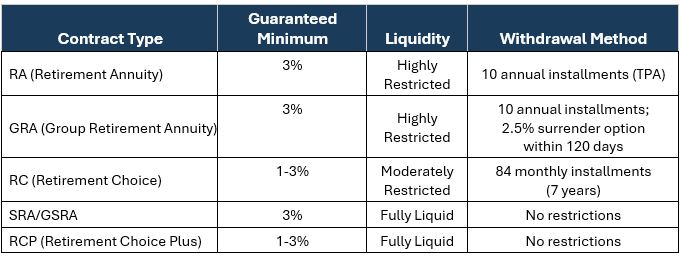
The single most critical factor in managing TIAA Traditional is understanding which contract type governs your holdings. TIAA offers several contract structures, each with different liquidity rules and guaranteed minimum interest rates. Most participants hold their TIAA Traditional balances in one or more of the following contract types:
Retirement Annuity (RA) and Group Retirement Annuity (GRA)
These “legacy” contracts represent the classic TIAA structure, common among long-tenured faculty and staff who have been contributing for decades. Many institutions have frozen these contracts to new contributions, though existing balances remain in place (e.g., Duke University Human Resources, 2024).
- Guaranteed Minimum Rate: 3% during the accumulation phase.[12]
- Liquidity Status: Highly restricted.[13]
- Withdrawal Method: For RA contracts, lump-sum withdrawals from TIAA Traditional are not available. Subject to employer plan terms, all withdrawals and transfers must be paid in 10 annual installments over nine years and one day via the Transfer Payout Annuity (TPA).[14]
- GRA Exception: For GRA contracts, lump-sum withdrawals may be available within 120 days after termination of employment, subject to a 2.5% surrender charge.[15]
Retirement Choice (RC)
The Retirement Choice contract is the modern standard for many university plans. It offers somewhat greater liquidity than legacy contracts but with a variable guaranteed minimum rate.
- Guaranteed Minimum Rate: Between 1% and 3%, determined annually based on the 5-year Constant Maturity Treasury rate.[16]
- Liquidity Status: Moderately restricted.[17]
- Withdrawal Method: Withdrawals and transfers from TIAA Traditional must be paid in 84 monthly installments (7 years). Lump-sum withdrawals may be available within 120 days after termination of employment, subject to a 2.5% surrender charge.[18]
Supplemental Contracts: SRA, GSRA, and RCP
Supplemental Retirement Annuities (SRA), Group Supplemental Retirement Annuities (GSRA), and Retirement Choice Plus (RCP) contracts are typically used for voluntary employee contributions or specific rollover accounts.
- Guaranteed Minimum Rate: 3% for SRA/GSRA; 1-3% (variable) for RCP.[19]
- Liquidity Status: Fully liquid.[20]
- Trade-off: These contracts generally offer lower crediting rates than their illiquid counterparts – typically 0.25% to 0.75% less – reflecting the cost of providing full liquidity.[21]
Contract Comparison Summary
Sources: Please refer to the text, above.
Methods for Accessing TIAA Traditional Funds
The Transfer Payout Annuity (TPA)
For participants holding substantial assets in RA or GRA contracts, the Transfer Payout Annuity is the primary mechanism for accessing TIAA Traditional funds. The TPA is not a lifetime annuitization; rather, it is a systematic liquidation of your account over a specified period.[1]
How the TPA Works:
- You request to transfer a specific dollar amount (or the entire balance) out of TIAA Traditional.
- TIAA creates a new Transfer Payout Annuity contract. Each year, approximately 10% of the value (plus any earnings) is transferred to your designated destination – either other funds within your TIAA plan or an external rollover IRA.
- During the payout period, the remaining balance continues to earn interest at a guaranteed minimum of 2.5% for RA/GRA contracts, plus any additional amounts declared by the Board.[2]
- Once the TPA is established, it generally cannot be revoked, though you may be able to convert the remaining balance to a lifetime annuity.[3]
Strategic Planning Insight: Because the TPA requires a multi-year payout period, initiating a TPA well before you need the funds can be advantageous. For example, a 62-year-old planning to retire at 67 might initiate a TPA immediately; by retirement, half the balance would already be liquid. This “starting the clock early” approach provides flexibility without sacrificing the benefits of remaining invested in TIAA Traditional.
Interest-Only Payments
For retirees who do not need to draw down principal but desire regular income, TIAA offers an Interest-Only Payment option for RA and GRA contracts. This option allows you to receive only the interest credited to your account while keeping your principal intact.[4]
Key Parameters:
- Age Requirement: You must be between age 55 and one year prior to your Required Minimum Distribution (RMD) applicable age.[5]
- Minimum Balance: Generally requires an accumulation of at least $10,000.[6]
- Flexibility: You can transition from Interest-Only payments to a Transfer Payout Annuity or lifetime annuitization, but you generally cannot simply “turn off” the Interest-Only option without selecting an alternative payout method.[7]
This option can serve as an excellent “bridge” strategy for retirees who have stopped working but are waiting to maximize Social Security benefits by delaying claims until age 70.
Lifetime Annuitization
TIAA Traditional is fundamentally designed to be converted into lifetime income. When you annuitize, you exchange your accumulated balance for a guaranteed stream of payments that continues for as long as you live – or for your life and that of a designated annuity partner.
The Role of Mortality Credits: Academic research on annuities consistently demonstrates the value of “mortality credits” – the mechanism by which insurance companies can offer higher lifetime income than individuals could safely generate on their own. Those who die earlier than average effectively subsidize payments to those who live longer, allowing the insurance company to offer payouts that exceed what a self-managed withdrawal strategy could sustain.[8] A Wharton Financial Institutions Center study concluded that self-insuring against longevity risk requires saving 25% to 40% more than with an annuity because of the absence of risk-pooling and mortality credits.[9]
The TIAA Loyalty Bonus: For long-term holders of TIAA Traditional who choose to annuitize, TIAA may provide a “Loyalty Bonus” – an additional amount of lifetime income based on how long the participant has been investing in TIAA Traditional. According to TIAA, participants who have contributed consistently over time have received, on average, a 22.4% higher initial lifetime income payment compared to those who deposited a lump sum immediately before annuitizing.[10] The Loyalty Bonus reflects unused contingency reserves being returned to long-term participants.[11] However, it is important to understand that the Loyalty Bonus is discretionary and determined annually by TIAA’s Board of Trustees – it is not guaranteed.[12]
When to Consider Annuitization:
- Insufficient Guaranteed Income: If Social Security and any pension income do not cover your essential fixed expenses (housing, healthcare, food), annuitizing a portion of TIAA Traditional can create a guaranteed income floor.
- Portfolio Risk Management: Annuitized income can function as a “bond proxy,” potentially allowing you to hold a higher allocation to equities in the remainder of your portfolio since your income floor is secured.
Important Caution: Annuitization is irrevocable. Once you convert your balance to lifetime income, you cannot recover the principal or change to a different option.[13] Therefore, many financial professionals recommend partial annuitization rather than annuitizing 100% of your TIAA Traditional balance, preserving some liquid assets for unexpected needs and legacy goals.
TIAA Traditional in an Evidence-Based Portfolio Context
Modern portfolio theory and evidence-based investing principles generally favor broadly diversified, low-cost investment vehicles. This typically leads advisors to recommend index funds and exchange-traded funds over higher-cost actively managed products, including many variable annuities.
However, TIAA Traditional merits special consideration as an exception to general anti-annuity sentiment for several reasons:
- Principal Protection: Unlike bond funds, TIAA Traditional provides a contractual guarantee that your balance will never decline due to interest rate fluctuations or market conditions.[35]
- Competitive Returns: TIAA Traditional has historically paid more than its guaranteed minimum rate every year since 1948.[36] Current crediting rates often exceed comparable investment-grade bond fund yields while providing zero principal fluctuation.[37]
- Diversification Benefits: The General Account’s allocation to real assets (real estate, timber, farmland) provides exposure to asset classes not readily available in typical retail investment products.[38]
- Low Cost: Because TIAA operates without public shareholders and with relatively low distribution costs, expense ratios are minimal compared to commercial insurance products.[39]
From this perspective, TIAA Traditional can serve as the “safe” anchor of a retirement portfolio – replacing the role that Treasury bonds or stable value funds might otherwise play – while allowing the investor to take appropriate equity risk elsewhere.
Practical Recommendations
- Identify Your Contract Types: Review your quarterly TIAA statements to determine exactly which contract codes (RA, GRA, RC, RCP, SRA, GSRA) govern your holdings. Each has different liquidity rules that will affect your retirement income planning.
- Map Your Liquidity Timeline: If you hold RA or GRA contracts, plan your exit strategy years before you need the funds. Consider initiating a TPA well ahead of retirement to “start the clock” on the 10-year payout period.
- Evaluate the Interest-Only Option: If you are between age 55 and your RMD age, Interest-Only payments may provide a useful bridge income while preserving your principal.
- Consider Partial Annuitization: If your guaranteed income from Social Security and pensions does not cover essential expenses, annuitizing a portion of your TIAA Traditional can close that gap while maintaining liquidity elsewhere.
- Consult a Qualified Advisor: Given the complexity of TIAA Traditional’s contract structures and the irrevocability of some decisions, consider working with a fee-only financial advisor who has specific experience with TIAA products.
Conclusion
TIAA Traditional represents a unique financial instrument that combines insurance guarantees with competitive investment returns. While its liquidity constraints can feel restrictive, these constraints are the price for the product’s distinctive benefits: guaranteed principal, competitive crediting rates, and access to mortality credits through lifetime annuitization.
By understanding the specific rules governing your contract types and planning proactively, you can harness the security that TIAA Traditional offers while maintaining the flexibility needed for a successful retirement. The key is education, planning, and a clear-eyed assessment of your individual needs for guaranteed income versus portfolio liquidity.
Enjoyed this article?
We write about these topics because we believe informed people make better financial decisions. If that resonates, we’d love to stay in touch.
Sign up for our e-newsletter and receive “Ten Tough Questions You Should Ask Any Financial Advisor” — a free PDF guide to help you find a fiduciary, fee-only advisor you can truly trust.
About the Authors
Ron A. Rhoades, JD, CFP®
Ron Rhoades is an Associate Professor of Finance at the Gordon Ford College of Business, Western Kentucky University. He also serves as a financial advisor at Scholar Financial, a practice within XY Investment Solutions LLC. With a background as both an attorney and a CERTIFIED FINANCIAL PLANNER™ professional, Ron is a nationally recognized authority on the fiduciary duties of financial advisors.
Chris Brown, Ph.D., CFP®
Chris Brown is a faculty member in the Department of Finance at the Gordon Ford College of Business, Western Kentucky University, and a financial advisor at Scholar Financial, a practice within XY Investment Solutions, LLC. He holds the CERTIFIED FINANCIAL PLANNER™ designation and a Ph.D. in Personal Financial Planning. His research and teaching focus is on behavioral finance, retirement planning, and evidence-based investment strategies.
Disclosure
This article is for educational purposes only. Scenarios and references to client experiences are used solely to illustrate financial planning concepts. These examples may not apply to your individual circumstances. It should not be construed as financial, legal, tax, or investment advice, nor as a recommendation to implement any specific strategy, product, or investment. As a fiduciary, we provide advice tailored to each client’s goals and financial situation. Consult with a qualified financial professional before making investment decisions.
Prices, values, and other data are obtained from sources deemed reliable at the time of use, but accuracy is not guaranteed.
Advisory services are offered through XYPN Sapphire and its various IAR brands under which it operates. XYPN Sapphire is an SEC registered investment adviser. For additional disclosure and privacy information, please visit XYPNSapphire.com/disclosures.
Footnotes
- Carnegie Corporation of New York, n.d.; Encyclopedia.com, n.d.
- TIAA, 2025a.
- TIAA, 2025b.
- TIAA, 2025b.
- TIAA, 2025c.
- TIAA, 2024a.
- TIAA, 2025i.
- TIAA, 2025b.
- TIAA, 2024b.
- Fitch Ratings, 2025.
- Bernard, 1997.
- TIAA, n.d.
- TIAA, 2025j.
- TIAA, 2025d.
- TIAA, 2025d.
- TIAA, 2025e.
- TIAA, 2025j.
- TIAA, 2025e.
- TIAA, n.d.
- TIAA, 2025j.
- Ibid.
- TIAA, 2025f.
- TIAA, n.d..
- TIAA, 2025f.
- TIAA, 2025g.
- TIAA, 2025g.
- University of Michigan HR, 2025.
- TIAA SPD, n.d.
- Medical Economics, 2024; Center for Retirement Research, 2023.
- Medical Economics, 2024.
- TIAA, 2025h.
- TIAA, 2021.
- S&A Financial Services, n.d.
- TIAA, 2025h.
- TIAA Retirement Check, n.d.
- TIAA, 2024c.
- TIAA, 2024c.
- TIAA, 2024d.
- TIAA Retirement plan expenses, n.d.
References
Bernard, T. S. (1997, July 30). Budget deal to cost T.I.A.A.–C.R.E.F. its tax exemption. The New York Times. Retrieved from https://irahelp.com/sites/default/files/private/articles/pdf/NY-Times-TIAA%20Sales%20Practices-10-22-17.pdf. See also Wikipedia. (2025). TIAA. https://en.wikipedia.org/wiki/TIAA
Bogleheads. (2023, September 22). TIAA Traditional Transfer Payout Annuity rates and Secure Act 2.0 [Forum discussion]. https://www.bogleheads.org/forum/viewtopic.php?t=413205
Bogleheads. (2025, January). TIAA Traditional (Retirement Choice – RC) interest-only option – questions [Forum discussion]. https://www.bogleheads.org/forum/viewtopic.php?t=446943
Carnegie Corporation of New York. (n.d.). The origins of the Carnegie Foundation for the Advancement of Teaching and the birth of TIAA-CREF. https://www.carnegie.org/news/articles/origins-carnegie-foundation-advancement-teaching-and-birth-tiaa-cref/
Center for Retirement Research at Boston College. (2023). Longevity risk: An essay. https://crr.bc.edu/wp-content/uploads/2023/11/2023_Longevity-Risk-1.pdf
Duke University Human Resources. (2024, April 10). TIAA Traditional Annuity. https://hr.duke.edu/benefits/retirement/403b/investment/tiaa-traditional-annuity/
Encyclopedia.com. (n.d.). Teachers Insurance and Annuity Association. https://www.encyclopedia.com/books/politics-and-business-magazines/teachers-insurance-and-annuity-association
Fitch Ratings. (2025). Teachers Ins. and Annuity Assoc. of America [Credit rating report]. https://www.tiaa.org/public/pdf/ratings_insurance/fitch.pdf
Medical Economics. (2024, October 30). Why lifetime annuities can offer valuable “longevity insurance.” https://www.medicaleconomics.com/view/why-lifetime-annuities-can-offer-valuable-longevity-insurance-
Nuveen. (2024, July 1). Views from TIAA General Account. https://www.nuveen.com/global/insights/investment-outlook/views-from-tiaa-ga-june-2024
Penobscot Financial Advisors. (2022, August 8). The mysterious TIAA Traditional Annuity. https://penobscotfa.com/the-mysterious-tiaa-traditional-annuity/
S&A Financial Services. (n.d.). TIAA Traditional Loyalty Bonus. https://www.safinancialservices.com/blog/tiaa-traditional-loyalty-bonus
The Planning Center. (2024, February 5). A simple guide to understanding TIAA’s unique structure. https://www.theplanningcenter.com/guide-to-understanding-tiaas-unique-structure/
TIAA. (2021, December 16). TIAA Traditional payout increases 5% for 2022 [Press release]. https://www.prnewswire.com/news-releases/tiaa-traditional-payout-increases-5-for-2022-301446523.html
TIAA. (2024a). Building a resilient general account portfolio. Nuveen. Retrieved from https://www.nuveen.com/global/insights/investment-outlook/views-from-tiaa-ga-june-2024
TIAA. (2024b). Better retirements start with guarantees: Frequently asked questions about TIAA Traditional [Brochure, at fn.8] https://www.tiaa.org/public/pdf/t/TT_FAQ.pdf
TIAA. (2024c). TIAA Traditional Interest Rates Remain High. [Press Release]. TIAA. https://www.tiaa.org/public/about-tiaa/news-press/press-releases/2024/03-04
TIAA. (2024d). Under the hood of the TIAA General Account. TIAA. https://www.tiaa.org/public/pdf/t/tiaa-generally-speaking-october-2024.pdf
TIAA. (2025a). Who we are. https://www.tiaa.org
TIAA. (2025b). TIAA retirement product primer. https://www.tiaa.org/public/pdf/t/tiaa-retirement-product-primer.pdf
TIAA. (2025c). TIAA General Account financial strength. https://www.tiaa.org/public/pdf/performance/retirement/profiles/TIAA_Gen_Act_Fin_Strength.pdf
TIAA. (2025d). Frequently asked questions (FAQs) about TIAA Traditional. https://www.tiaa.org/public/pdf/t/TT_FAQ.pdf
TIAA. (2025e). TIAA Traditional Annuity – Retirement Choice (RC) fact sheet. https://fluenttech.tiaa.org/pdf/factsheet/878094101-TIAAPRC.pdf
TIAA. (2025f). Cash withdrawal or rollover Transfer Payout Annuity for private employer plans [Form F10794]. https://www.tiaa.org/public/pdf/forms/F10794_TPA_to_Cash_15_Fillable.pdf
TIAA. (2025g). Authorization of interest-only payments (ERISA) [Form F6776]. https://www.tiaa.org/public/pdf/forms/F6776_Completing_Your_Authorization_Form_Fillable_11.pdf
TIAA. (2025h). The opportunity for long-term TIAA Traditional contributors: TIAA Loyalty Bonus. https://www.tiaa.org/public/pdf/t/tiaa-traditional-loyalty-bonus.pdf
TIAA. (2025i). How TIAA’s General Account invests for the long term. Retrieved from https://www.tiaa.org/public/plansponsors/insights/tmrw/edition-3/how-tiaa-manages-americas-retirement-money
TIAA. (2025j). Understanding annuity liquidity and withdrawals. https://www.tiaa.org/public/plansponsors/insights/tmrw/edition-6/annuity-liquidity
TIAA. (n.d.). Understanding your Retirement Choice Plus annuity account: TIAA and CREF annuity account comparison chart. https://www.tiaa.org/content/dam/tiaa/microsites/pdfs/announcement/suny_comparisonchart.pdf
TIAA Retirement Check (n.d.). Teachers Insurance and Annuity Association of America. (n.d.). TIAA Traditional Annuity: Guaranteed Monthly Retirement Check. TIAA. https://www.tiaa.org/public/retire/financial-products/annuities/retirement-plan-annuities/tiaa-traditional-annuity
TIAA Retirement plan expenses (n.d.). Retirement plan expenses, credits, and fees. TIAA. https://www.tiaa.org/public/pdf/fee-leveling-insert.pdf
TIAA SPD (n.d.). Retirement Plan (Summary Plan Description). https://www.tiaa.org/content/dam/tiaa/microsites/pdfs/plan-document/spd/spd_dd370df111fd74543913b2f2b87eff7b.pdf
University of Michigan Human Resources. (2025, September 22). Your retirement income options. https://hr.umich.edu/benefits-wellness/financial/retirement-savings-plans/your-retirement-income-options


